 English
 简体中文

Short answer: Stage V fills the engine bay with after-treatment and the EU noise directive caps sound power by power band - and both land on the chassis. Three trends are now predictable: drives moving from fast motors with large reducers to low-speed high-torque direct drives, track shoe profiles redesigned for noise, and a rising share of steel-body chassis with swappable rubber pads for urban machines.
1. Three paths from emission rules to chassis
Stage V adds DPF and SCR volume of roughly 15-25 percent in the same power class, and that volume is borrowed from the chassis: frame mid-sections open up for service access, coolers and tanks restack. For custom chassis the effect is direct - upper-structure interface drawings change generation, and the two hardest rows on the interface sheet, cooling exhaust direction and exhaust routing, get harder still.
Path two is weight: after-treatment adds mass at the front of the upper structure, moving the CG forward, so ground-pressure distribution and longitudinal stability need re-verification. Path three is heat: SCR wants higher exhaust temperatures, bay temperatures rise, and design temperature limits for valve blocks and motor drain lines sitting near the engine move up 10-15 degrees C.
2. Noise: the running gear becomes the protagonist
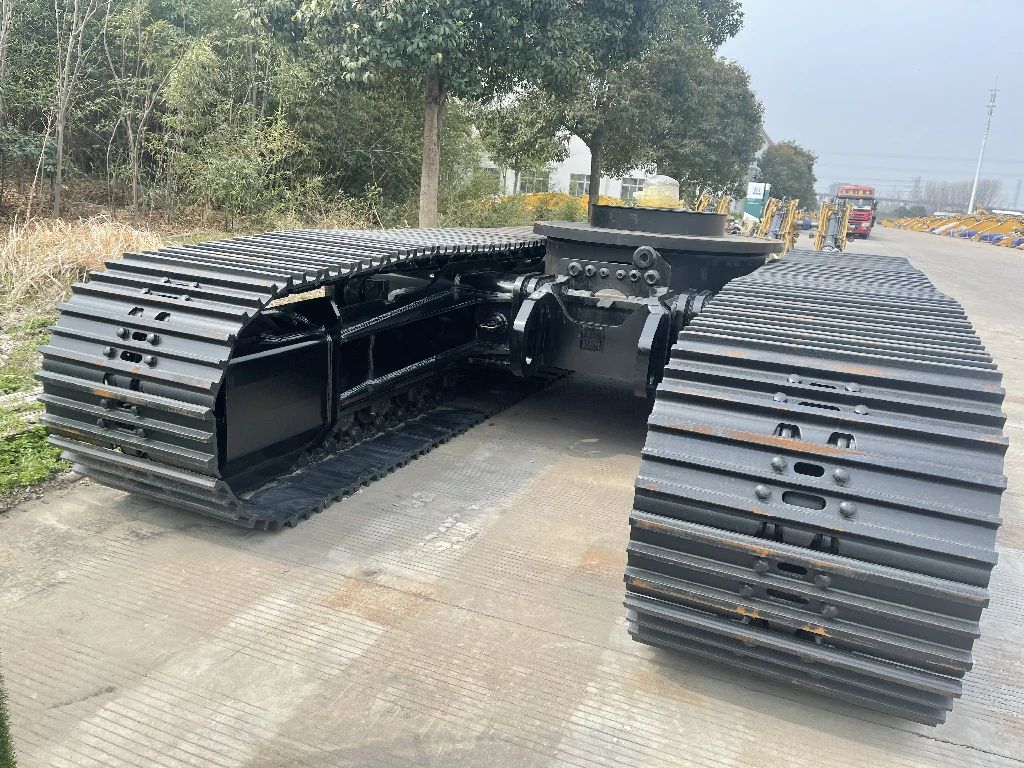
The EU 2000/14/EC directive caps guaranteed sound power by power band, and city machines face local night-work limits on top. Measured on 30-50 kW tracked machines below 3 km/h, sprocket and track mechanical noise can exceed the engine itself - at low speed the engine is quiet and the shoe-engagement impact and rail slap dominate. Three levers exist: sprocket tooth-profile correction to soften engagement, low-noise contact profiles on the shoes, and tighter bushing clearance to kill slap.
Rubber's noise advantage gets re-priced in this segment: 3-5 dB(A) better than steel under equal duty, often the difference between holding and losing a night-work permit on municipal machines. Steel's answer is not retreat but the hybrid - steel roller bodies with swappable rubber pads, taking the noise benefit and keeping steel durability, at a cost between the two.
3. Three practical effects on chassis procurement
First, state noise and emission targets at RFQ stage: if the machine carries a sound-power target, the drive configuration (motor displacement, reduction ratio, shoe type) must enter concept design - after the chassis freezes, there is almost no room left. Second, start the cooling-packaging negotiation early: frame openings and airflow paths against the upper bay now need an extra interaction round versus traditional projects. Third, hybrid solutions change the spares logic: pads are wear parts with a shelf life, so order the spares package and storage conditions with the contract.
4. Outlook
Electrification relieves emissions but sharpens noise: with the engine gone, the running gear becomes the dominant audible source, and chassis acoustic design weight only rises. In the next platform generation, sound power level will sit beside ground pressure and payload capacity as a basic specification. MAGEON has added an acoustic station to the test rig and can supply drive-configuration-level noise comparisons on request.
5. Regulation-to-chassis change list
| Rule pressure | Direct chassis effect | Design response |
|---|---|---|
| Stage V after-treatment volume | Bay space -15-25% | Frame zoning, re-routed lines |
| Forward CG shift | Pressure distribution, longitudinal stability | Gauge/CG re-verification |
| Noise caps by power band | Low-speed track noise dominates | Tooth correction, low-noise shoes, tighter bushings |
| Urban night limits | Rising rubber share | Steel body + swappable rubber pads |
Key takeaways
- Stage V costs the upper bay 15-25 percent of volume; chassis packaging, pressure distribution and thermal limits all need re-verification.
- Below 3 km/h, track mechanical noise can exceed the engine - the running gear is now the protagonist of noise control.
- Rubber runs 3-5 dB(A) quieter than steel; the hybrid steel-body-plus-pads solution holds both noise and durability.
- Declare noise targets at RFQ - after the chassis freezes, there is almost no acoustic room left.
Further reading
Rubber Track Undercarriage (Hydraulic Drive) · Rubber-Pad Steel Track Undercarriage · Industry trends column
Prepared by the MAGEON engineering team from custom project records and factory load-test data. Figures are engineering references; final selection should follow approved drawings and the actual duty spectrum.