 English
 简体中文

Several things happening in the crawler undercarriage industry today no longer work the way machine development did a decade ago. Rather than predicting the future, this article sets out three trends that have already taken hold - and what each one means for a purchasing decision.
1. Modular Design Is Lowering the Barrier to Customisation
The traditional route to a bespoke undercarriage was to design from scratch: drawings, tooling, pilot build, rework. Each step added cost and time in a straight line, and that linearity was the root cause of a high customisation barrier.
A modular approach decomposes the chassis into functionally independent modules - travel module (frame and wheel set), drive module (motor and gearbox), tensioning module, interface module - and builds a standard size range within each. A machine builder changes one module without disturbing the others.
Three practical consequences for buyers:
| Dimension | Traditional custom build | Modular approach |
|---|---|---|
| Design cycle | New design, 4-8 weeks | Module selection, 1-2 weeks |
| Tooling investment | Amortised per order | Shared across standard parts |
| Impact of a change | Cascades through the whole frame | Local adjustment, rest reused |
| Minimum order | Typically 2-3 units | Some modules from one unit |
Modularity is not universal, and that matters. It pays where interface standardisation is high, typically for mid-size chassis. Above 80 tonnes, or for structures like triangular tracks, the benefit is eroded by structural difference.
2. Predictive Maintenance Is Reshaping Spares Strategy
The conventional spares approach stocks a percentage based on experience, which is unsatisfactory at both ends: too little means waiting for a part, too much ties up capital in stock that mostly will not be used within its shelf life.
Three conditions have now matured:
1. Wear data can be collected.Grouser height and pin clearance can be captured through markers or sensors, producing a per-unit record rather than an impression.
2. Data can be pooled.Aggregated across a fleet, the correlation between wear rate and duty becomes quantified instead of anecdotal.
3. Supply response can be shortened.Modular spare structure means single-part replacement rather than set replacement, cutting response from a set order to a single shipment.
The effect on purchasing is that spare budget allocation can shift from proportional stocking to condition-based tiering. High-intensity machines get frequent replacement parts, low-intensity machines get long-cycle items. The basis for this judgement is written out in the component replacement criteria in Maintenance Knowledge.
3. Electrification and Lightweighting Are Changing Materials and Structures
The most direct effect of electrification on the chassis is weight distribution. A battery pack introduces concentrated mass and a rearward centre of gravity shift, which places new demands on longitudinal stiffness and counterweight distribution. Swapping lead-acid for lithium is not the whole story - the frame's centre of gravity design has to move with it.
Two material directions are worth watching:
Broader use of high-strength steel.Achieving the same load capacity with thinner plate reduces weight by 8-15%, which converts directly into lower ground pressure or higher tractive force.
Evolution in rubber track compounds.Formulation balances abrasion resistance, tear resistance and low-temperature flexibility, extending the usable envelope of rubber tracks toward -25°C and longer high-temperature service.
4. What These Trends Mean for a Buying Decision
Translating the three trends into practical decisions:
1. Prioritise suppliers with genuine modular capability.Not because it is cheaper, but because future adjustments avoid the cost of redesign and re-tooling. Put "can a module be changed without altering the frame" into your supplier questionnaire.
2. Include wear data capability in the assessment.A supplier that supplies a log template and trend analysis reduces total cost of ownership over time, because most chassis cost eventually shows up in downtime and wear parts rather than in the purchase price.
3. Judge structural capability, not the spec sheet.Numbers across suppliers tend to converge. The real difference lies in whether the supplier can cooperate on structural optimisation for your machine, which requires chassis design capability rather than assembly capability.
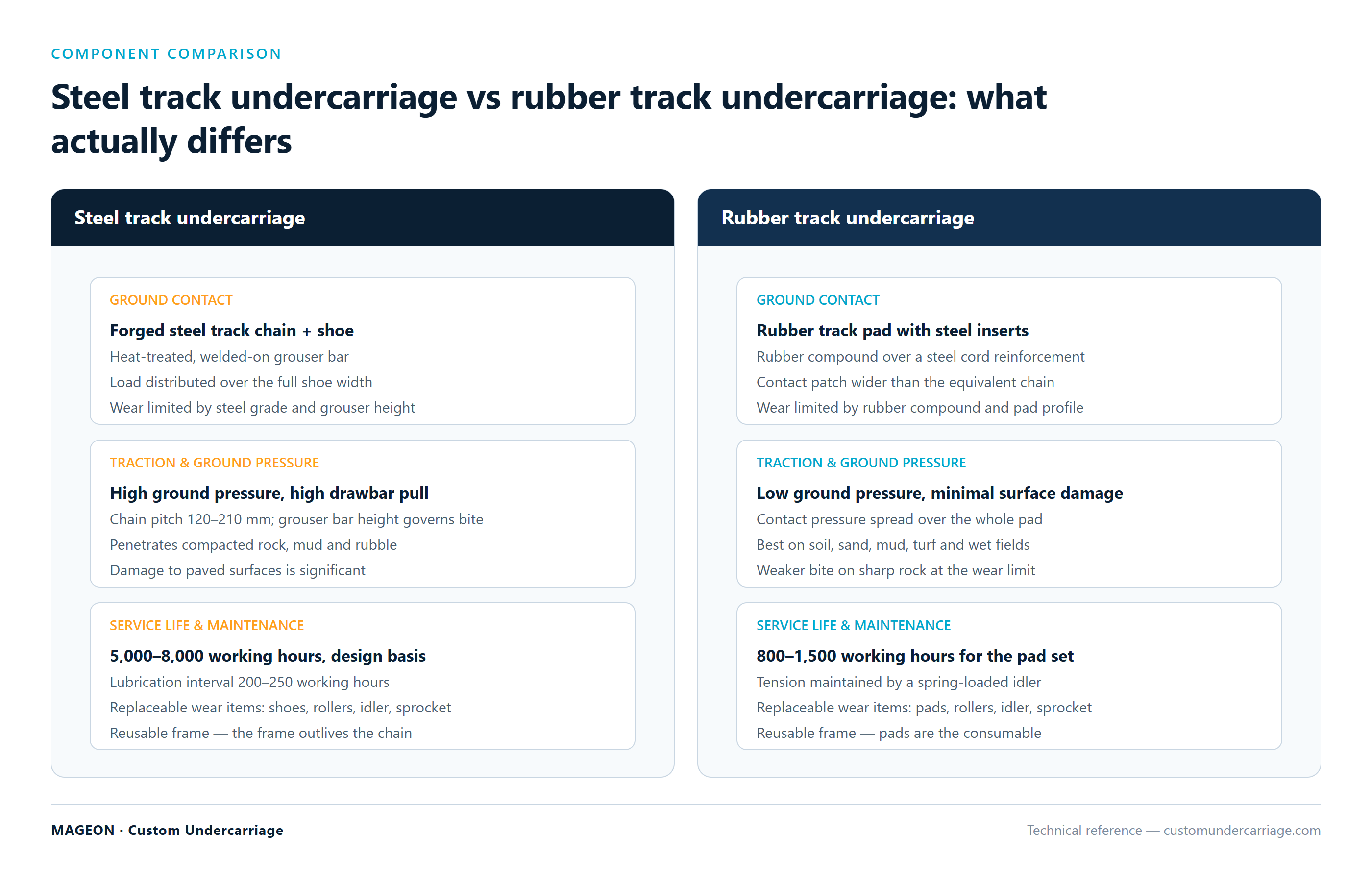
To see how these trends appear in practice, review the specification systems behind Steel Crawler Undercarriage and Rubber Crawler Undercarriage. For methods of implementing this, see Selection Guide, and our recent technical output and case work is collected in Technical Support and Case Studies.