 English
 简体中文

For an electric construction machine, the track chassis choice is not a matter of taste — it is a decision about rolling resistance, ground pressure and how far a battery can realistically take the machine. A rubber track chassis is generally the better starting point for compact electrified machines below 15 tons, because a full-width rubber pad spreads the load and returns the battery's energy as distance rather than heat. A steel track chassis remains the correct choice for heavy electrified machines above 15 tons and for any duty on rock or hardpan, where the chain's mechanical bite and 5,000–8,000 working hour life outweigh the higher rolling resistance. MAGEON builds both, from 1 to 60 tons in steel and 1 to 15 tons in rubber, and the decision for an electrified platform follows the same logic as any other chassis decision — with one extra constraint added on top.
That extra constraint is energy. Electric machines are limited by battery capacity, and the undercarriage is the largest single parasitic load on the battery after the working tool. Getting the track material wrong on an electric machine costs range directly, which is why the question deserves its own answer rather than a general steel-versus-rubber discussion.
How does the track chassis affect an electric machine's range?
The undercarriage consumes battery through rolling resistance, and rolling resistance differs sharply between the two materials. A rubber track undercarriage spreads the machine's weight across the full pad width, which keeps the pad on top of soft ground rather than sinking into it, and the resulting low ground pressure translates directly into less energy spent climbing out of the machine's own rut. On soil, sand, mud and turf, a rubber track chassis can return a materially longer working range from the same battery.
A steel track chassis concentrates the load on the grouser bar, which is exactly what you want for digging into rock but exactly what you do not want when the machine has to travel across soft ground — the track sinks, the resistance climbs, and the battery drains faster for the same distance. On hard, compacted surfaces the gap narrows, but on anything soft the rubber track's rolling advantage is significant.
The practical consequence for an equipment manufacturer is that range is not a battery-only problem. A machine spec'd with the wrong track material can lose a meaningful share of its nominal range before it has moved a single bucket, and no amount of battery can recover what the undercarriage throws away as heat.
At what machine weight does steel take over?
At around 15 tons. MAGEON's rubber track undercarriage range is engineered for 1 to 15 tons, and the steel track undercarriage range covers 1 to 60 tons with 200–500 mm track width. The crossover is not arbitrary — a rubber pad's steel-cord reinforcement has a practical load ceiling, and above roughly 15 tons the pad life and the ground pressure profile stop being the right trade for an electrified platform.
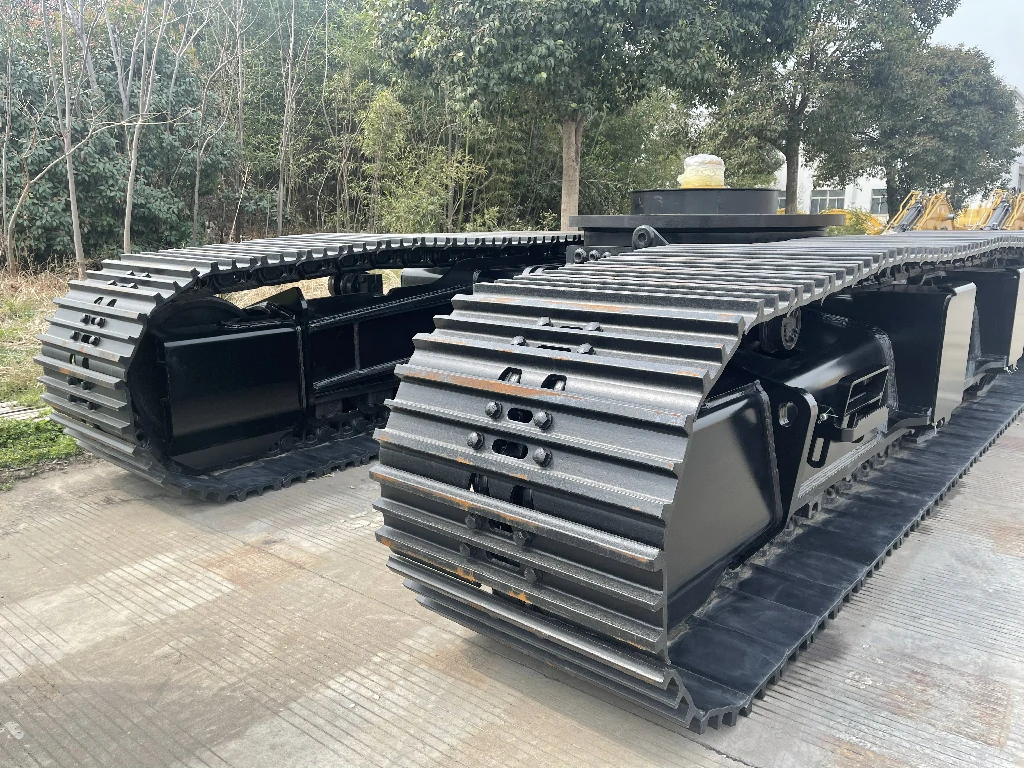
Above that point, a steel track chassis is the correct answer because the machine is heavy enough that a battery can only give it meaningful range if the frame and running gear are designed around it. MAGEON's steel chassis beam is Q345B high-strength steel, with the welded structure optimised for load capacity and torsional rigidity, and the chain delivers a 5,000–8,000 working hour planning life. An electrified excavator, drilling rig or crawler crane in the 15–60 ton class is, in practice, a steel-track machine.
What is the weight penalty of each material?
Steel carries a weight penalty that matters more on an electric machine than on a diesel one. A steel chain and full steel running gear weigh more than an equivalent rubber track arrangement, and on a machine where the battery already dominates the mass budget, the undercarriage weight is a direct reduction in either payload or range. For a compact electrified machine under 15 tons, that weight saving is one of the reasons rubber is preferred.
The counterpoint is that a steel chassis also outlasts the alternatives, and on a heavy machine the frame is not consumed — the chain and shoes are. An electric machine's economics are different from a diesel machine's, but the wear-part arithmetic is not: rubber pads are replaced at 800–1,500 working hours in sections, while a steel chain is planned for 5,000–8,000 hours. Over a machine's full life, the lighter initial choice can become the more expensive running choice.
How does electrification change the drive interface?
Electrification changes what the chassis has to accept, not just what it weighs. An electric travel drive removes the hydraulic lines that run to the track frame, and MAGEON's steel track undercarriages are available with hydraulic, electric or mechanical drive matched to the customer's power system. For an electrified platform this matters in two ways: an electric travel motor eliminates a leak source and a failure point, and it removes the travel circuit from the machine's hydraulic power budget — which on a battery machine is exactly the budget that should not be spent on travel.
The drive shaft height, bolt pattern and mounting flange remain customised to the host structure regardless of the power source, so an electrified machine is specified the same way as any other — with the additional input of the battery's voltage, available power and the required duty cycle stated up front.
What should an OEM decide first when electrifying a machine?
Decide the duty before the track. If the machine works on turf, in landscaping, in agriculture or in municipal applications below 15 tons, a rubber track chassis is usually the correct electric platform, because the low ground pressure protects the surface and conserves battery range. If the machine is a mining, quarrying or heavy construction platform above 15 tons, a steel track chassis is the correct answer, because the ground is abrasive and the mechanical bite is what moves the work.
For machines that travel between a paved yard and a soft site — the classic drilling-rig or mobile-crusher pattern — the compromise is a steel track with rubber pads. MAGEON's 3–15 ton rubber-padded steel track undercarriage runs at 2–4 km/h and keeps the steel load path while the pads protect the surface, which for an electrified machine also means controlled rolling resistance on the hard sections.
| Consideration | Rubber track chassis | Steel track chassis |
|---|---|---|
| Load range | 1–15 tons | 1–60 tons |
| Rolling resistance on soft ground | Low (battery-friendly) | Higher (sinks, drains range) |
| Weight penalty | Lighter | Heavier |
| Wear-part life | 800–1,500 pad hours | 5,000–8,000 chain hours |
| Ground damage | Minimal | Significant on paving and turf |
| Drive options | Hydraulic (compact class) | Hydraulic / electric / mechanical |
Frequently asked questions
Do electric construction machines use rubber or steel tracks?
Compact electric machines under 15 tons, especially those working on soft or finished surfaces, are usually built on rubber track chassis because the low ground pressure conserves battery range and protects the surface. Heavy electric machines above 15 tons are built on steel track chassis because the load and the abrasive ground demand a chain. MAGEON supplies both, so the answer for a given machine follows the duty, not the power source.
How much range does the track choice actually cost?
On soft ground the difference is material, because a steel chain that sinks into soil spends battery energy climbing out of its own rut, while a rubber pad stays on top. On hard ground the gap is much smaller. The honest way to answer is per site: MAGEON engineers assess ground conditions as part of the requirement assessment precisely because the track material is a range decision on an electric machine, not just a wear decision.
Can an electric travel drive be fitted to a steel track chassis?
Yes. MAGEON's steel track undercarriages are available with hydraulic, electric or mechanical drive matched to the customer's power system. An electric travel motor removes the hydraulic lines to the track frame, eliminates a leak point, and frees the machine's hydraulic budget for the working tool — all of which matter more on a battery platform than on a diesel one.
What is the weight trade-off between steel and rubber?
A steel chain and running gear weigh more than a rubber track of equivalent capacity, and on an electric machine that weight is a direct reduction in range or payload. The counter is life: rubber pads are consumed at 800–1,500 working hours, while a steel chain is planned for 5,000–8,000 hours. Over a machine's life the lighter choice can become the more expensive one, so the decision should be made per operating hour, not per kilogram.
What should I tell MAGEON when enquiring about an electric platform?
State the machine's loaded weight and load distribution, the ground and duty conditions, the required travelling speed, the drive configuration, and the battery voltage and available power. Those inputs let MAGEON match the track material, width and drive package to the electrified duty, and the mounting flange, bolt pattern and drive shaft height are customised to your host structure as standard.
What is the MOQ and lead time for an electrified machine chassis?
The minimum order quantity is one set, so a first electrified prototype carries no batch penalty. Standard lead time is approximately 20 days for one set and 30 days for two to three sets, with longer timelines negotiated for volume orders. Every chassis ships with a one-year or 1,000-hour warranty under ISO 9001:2015 certification, with video inspection before dispatch.