 English
 简体中文

Short answer: The real constraint on this 5-ton mobile crusher was not load capacity but export transport: overall width had to stay under 2.3 m for a standard container, while the crusher and hopper sat off-centre, shifting the static centre of gravity about 180 mm. A split frame with detachable track shoes brought shipping width to 2.24 m, and a 120 mm wider operating track gauge recovered lateral stability.
1. The brief and the constraints behind it
The customer initially supplied three parameters: 5-ton machine, steel tracks, sea freight export. Detailed discussion surfaced two hard limits. Inland transport in the destination country was capped at 2.3 m before oversize permits became expensive, and the crusher plus feed hopper sat to one side, shifting the static centre of gravity roughly 180 mm off frame centre and loading one track continuously.
Those two limits pull in opposite directions. Stability wants a wider gauge; shipping wants a narrower envelope. A one-piece welded frame cannot satisfy both, so the layout was changed to a separable structure.
2. Split frame and detachable shoes
The frame was designed as a centre main beam with two bolted track beams located by fitted dowels and high-strength bolts, then rechecked at 1.25x rated static load after assembly. Track shoes were changed to individually bolted plates so the outer row could be removed and packed separately. Dowel holes were match-machined and steel-stamped in pairs to prevent reversed assembly on site.
Operating gauge was 120 mm wider than shipping gauge via a telescopic cross beam. That telescopic section was the only high-risk component, so it received a 50,000-cycle bench test with strain gauge data retained in the project file.
3. Interface sign-off and prototype validation
The interface sheet covered the machine mounting flange, hydraulic pressure and return sides, hopper support leg positions and service access clearance. The most common rework on comparable projects is a service door colliding with the track beam, so door swing was checked as a motion envelope in the 3D assembly rather than left to fitters.
The prototype ran 36 hours in-house: ground pressure 0.163 m2/t, maximum tractive effort 41 kN, no creep when parked on a 20 degree gradient, and 46C roller temperature rise over four continuous hours. Rollers on the eccentric side ran 4C warmer, inside the accepted band.
4. Shipping and delivery results
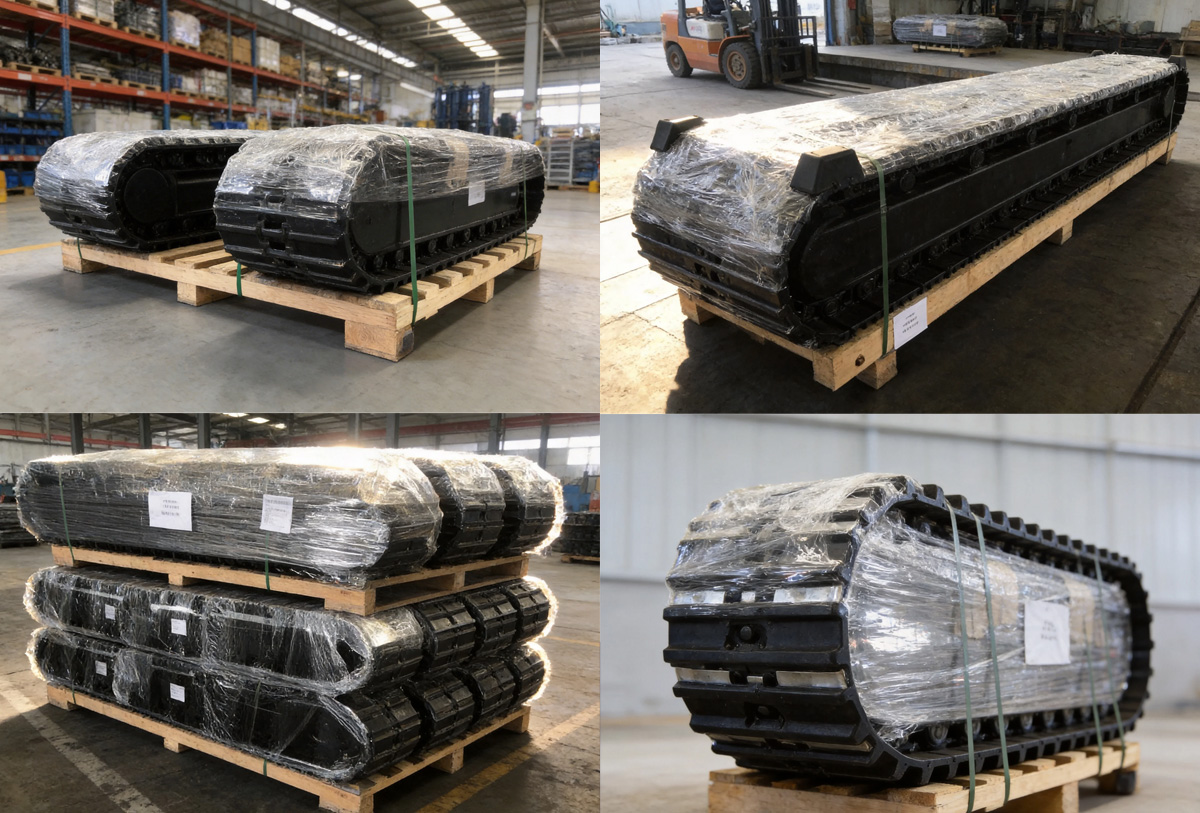
Shipping envelope was 2.24 m x 2.85 m x 0.92 m, allowing two units in one 40 ft high-cube container and cutting sea freight by roughly 40% against the original one-piece arrangement. On-site assembly took 3.5 hours using the supplied manual with no hole mismatch.
A batch of six followed five weeks after prototype approval, shipped with material traceability, weld MT reports, load test reports and an assembly torque table. The layout has since become our default transport template for exported crushing and screening machines.
5. Measured Acceptance Data
| Item | Target | Measured | Result |
|---|---|---|---|
| Shipping width | Under 2.30 m | 2.24 m | Pass |
| Ground pressure | At least 0.15 m2/t | 0.163 m2/t | Pass |
| Max tractive effort | At least 38 kN | 41 kN | Pass |
| 20 degree park | No creep | No creep | Pass |
| 4 h roller temp rise | Below 55C | 46C | Pass |
Key takeaways
- Export projects are usually governed by shipping width and centre of gravity, not by tonnage.
- A split frame plus detachable shoes held shipping width to 2.24 m without sacrificing operating gauge.
- Check service door swing as a 3D motion envelope for offset machines to avoid site rework.
- Match-machined, stamped dowel pairs are what make one-pass field assembly realistic.
Further reading
Case Studies · Steel Crawler Undercarriage · Technical Support · OEM/ODM
Prepared by the MAGEON engineering team from custom project records and factory load-test data. Figures are engineering references; final selection should follow approved drawings and the actual duty spectrum.