 English
 简体中文

This article walks through an 8-ton loader steel crawler undercarriage project from duty analysis to batch delivery, a cycle of eleven weeks. The value of the case is not the outcome but how it shows the full path from a loosely defined requirement to an acceptance-ready product - including three judgement calls that changed the final specification.
1. The Stated Requirement and the Real Constraint
The customer's first brief was simple: steel crawler undercarriage for an 8-ton loader, delivery within three months. By the second week of duty discussions, the real constraint emerged - it was not tonnage but abrasive concentration in the working surface.
This loader works primarily in an aggregate yard moving 6 tonnes of crushed stone daily, with high sand content in the working surface. Grouser wear in this duty runs three to four times the rate of normal earthmoving work. Delivering a standard configuration would have dropped shoe life from the expected 2,000 hours to under 700, and the customer's three-month running cost would have risen instead of fallen.
| Decision | Initial spec | Revised spec | Reason |
|---|---|---|---|
| Track shoe material | Standard Q355 plate | Thicker plate with quenched grousers | Grousers are the primary wear point in abrasive duty |
| Roller sealing | Standard dust seal | Double-lip seal with grease cavity | Dust ingress is the main cause of early bearing failure |
| Sprocket | Standard case-carburised teeth | One step higher tooth hardness | Chain elongation raises engagement stress |
| Spares kit | Standard three items | Adds one spare set of track shoes | Site capacity is good but the customer would not hold stock |
2. Selection: Trading Width Against Tonnage
The machine originally ran 4-ton rubber tracks, so switching to steel required recalculating ground pressure. At 8 tonnes gross weight with 500 mm shoes, ground pressure came to roughly 0.19 m²/t - adequate for the crushed stone yard. Because the customer might later work softer ground, we recommended moving to 600 mm shoes.
The cost was approximately 100 mm additional turning radius, meaning an extra steering input at the site gate. We placed this trade-off in the specification sheet for the customer's engineering lead to sign. Having the customer make an informed choice rather than deciding for them is the single most important principle in this kind of project.
3. Interface Sign-Off: Where Rework Costs the Most
The project produced exactly one rework, revealed at the second stage. The customer's frame flange drawing specified the outer diameter and six bolt holes, but omitted the dowel pin hole. The chassis bolted on, yet the machine could rotate about two degrees relative to the chassis, and that slop amplified pin and bore wear under load.
Our response was procedural: before releasing the 3D assembly drawing, we marked every hole on the customer's physical flange with a marking pen and confirmed them one by one, then wrote that check into the sign-off column of the interface confirmation sheet. This customer has attached the same sheet to all four subsequent projects since.
4. Pilot Validation and Recorded Data
The pilot unit completed 42 hours on the customer's site with the following results:
| Measured item | Target | Actual | Result |
|---|---|---|---|
| Ground pressure | ≥ 0.16 m²/t | 0.168 m²/t | Pass |
| Maximum tractive force | ≥ 62 kN | 67 kN | Pass |
| Loaded gradient capability | 20° | 21.5° | Pass |
| Grouser wear rate | < 0.12 mm/100 h | 0.09 mm/100 h | Better than expected |
| Wheel-set temperature rise (4 h continuous) | < 55°C | 48°C | Pass |
Grouser wear came in better than predicted, mainly from the thicker plate combined with quenched grousers. That data point became the default reference for subsequent projects in similar duty.
5. Batch Delivery and Outcome
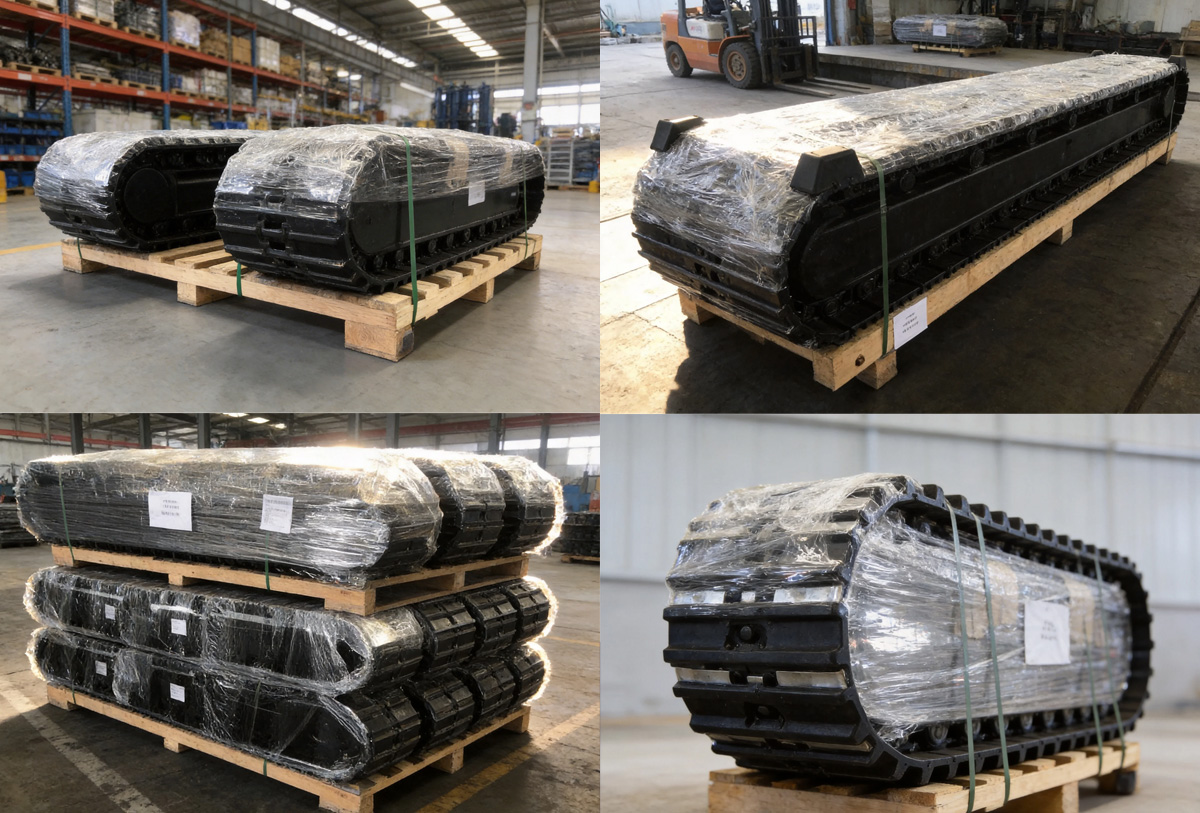
The batch of five units shipped six weeks after pilot data sign-off, arriving four days ahead of the contracted date. Batch consistency was verified on three fronts: traceability to heat numbers on critical parts, 100% first-pass yield on assembly clearances, and full pass on load testing.
Eight months into service, the customer reported actual shoe replacement intervals of 1,800-2,100 hours, matching the pilot projection closely. That means whole-life running cost was predictable from project kick-off - which is the core value a chassis supplier brings an OEM: not simply selling an undercarriage, but making the cost calculable.
6. What Transfers to the Next Project
Three lessons from this engagement became internal standard practice: first, duty discussions must reach sand content and ground type, because confirming only tonnage and machine model misses half the relevant information; second, the interface sheet must include the dowel, even when the customer drawing omits it; third, pilot data must be countersigned, since it becomes the baseline for batch acceptance and cost modelling.
If you are planning a comparable project, review the parameter checklist in Selection Guide or compare configurations for comparable machines in Applications. For an assessment of our product range and coverage, see Steel Crawler Undercarriage.