 English
 简体中文

Short answer: For a crawler undercarriage parked more than three months, the main risk is not rust but static damage: a chain held at high tension keeps pins and bushings loaded, shoes left under weight take a permanent set, and seal lips lose resilience in one fixed position. Release tension to the upper deflection limit, support the frame on timbers so the shoes carry no weight, cover against light, and rotate the track a quarter turn monthly.
1. Basic storage conditions
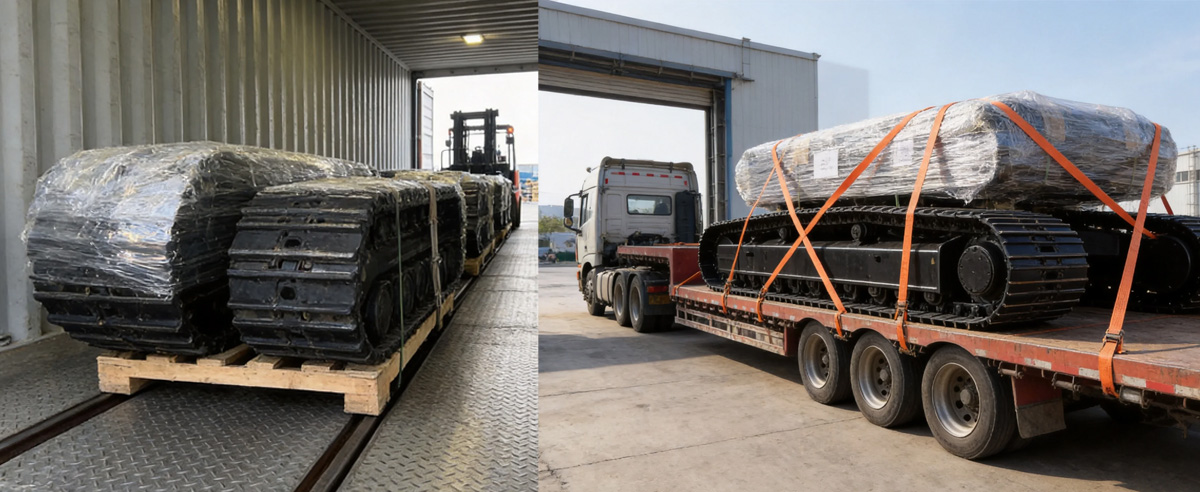
Indoor storage is preferred, with relative humidity below 70%. Outdoors, raise the machine at least 100 mm clear of standing water and use a breathable tarp rather than a sealed plastic wrap - condensation inside a sealed wrap damages roller cavities and electrics more than rain does.
Keep rubber tracks out of direct sunlight and away from ozone sources such as welding sets and high-frequency motors; a dedicated rubber protectant can be applied to the carcass. On steel tracks, coat machined faces, tensioner rods and flange bores with rust-preventive oil and fit protective caps.
2. Release tension and get the shoes off the ground
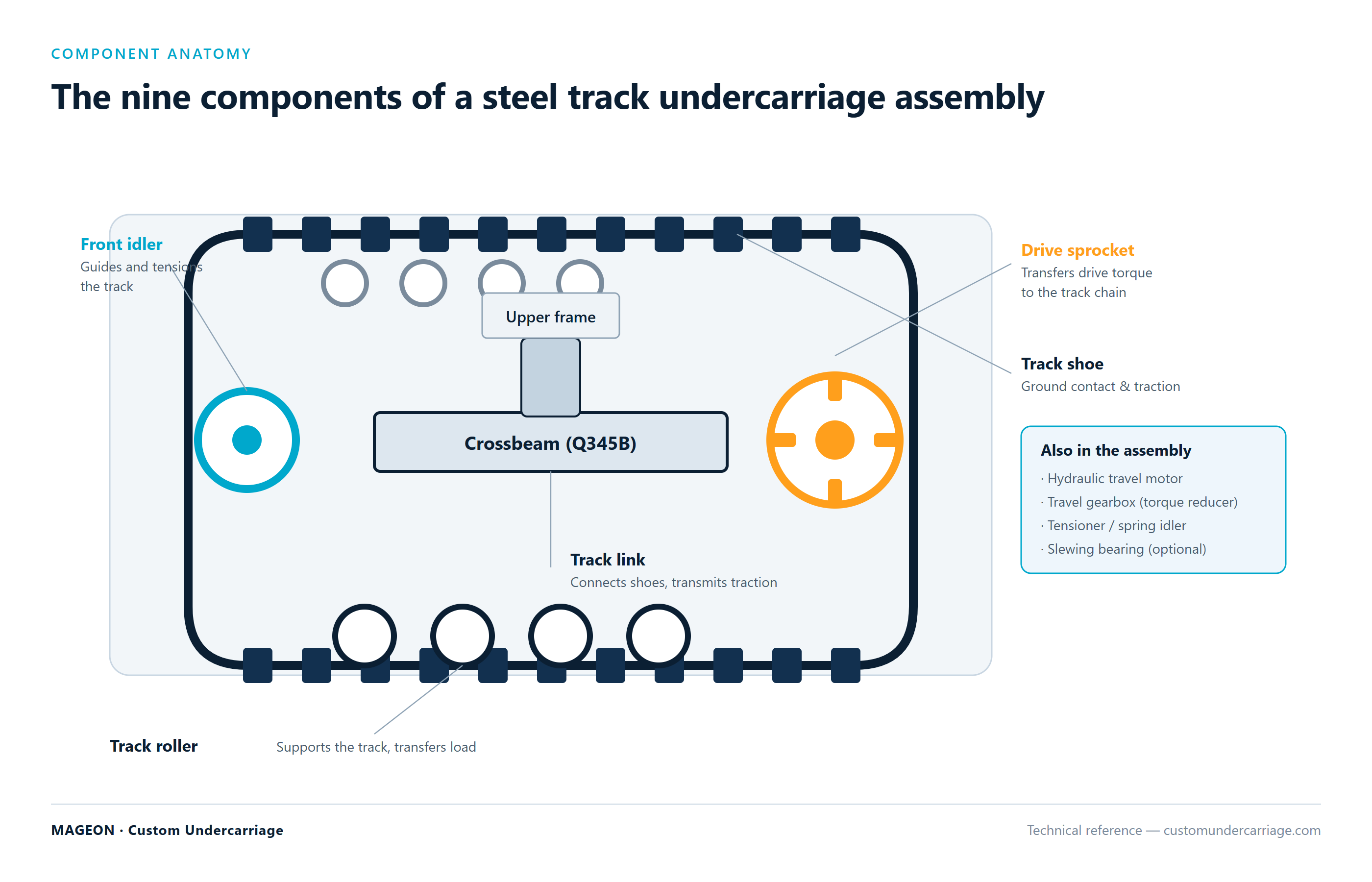
Bleed the tensioner to the upper recommended deflection, typically 50-60 mm, so the chain is relaxed. Support the frame on timbers so track shoes carry no machine weight. If the machine must stand on its tracks, move it a quarter of a track circumference monthly to change the contact position between shoes and rollers.
This step gets skipped because leaving a machine untouched feels safest. Local permanent deformation from long static loading shows up as periodic bouncing and noise after restart, and re-tensioning cannot undo it.
3. Fluids, seals and electrics
Top up final drive and hydraulic fluids to the standard level before storage to reduce condensation space inside the housing; beyond six months, follow the lubricant supplier's replacement guidance. Disconnect the battery negative, recharge periodically, and cap harness connectors.
Seals age with time rather than with running hours. Beyond twelve months of storage, inspect tensioner and roller lips for weeping before restart and replace by batch where necessary.
4. Twelve-point recommissioning check
Work in a fixed order: external corrosion and fasteners; shoe deformation and cracks; pins and retaining clips; tensioner reference line and deflection; chain pitch elongation; free roller rotation; lip seal leakage; final drive oil level and condition; hydraulic oil level and hoses; bolt torque recheck; brake and parking function; 15 minutes of unloaded low-speed running with temperature and noise checks.
Load progressively after the no-load run. Keep the first shift at or below 70% of rated load, then repeat the inspection at 50 hours before returning to the normal interval.
5. Storage Duration and Checks
| Duration | During storage | Recommissioning focus |
|---|---|---|
| 1 - 3 months | Quarter turn monthly | Tension, oil level, fasteners |
| 3 - 6 months | Add corrosion and condensation checks | Add lip seals and free roller rotation |
| 6 - 12 months | Consider oil change, recharge battery | Add pitch elongation and oil condition |
| Over 12 months | Assess seals by batch | Full 12 points + 70% load trial |
Key takeaways
- Static damage, not corrosion, is the primary long-storage risk; release tension and support the frame first.
- Outdoors use a breathable tarp, never a sealed plastic wrap, to avoid condensation.
- Rotate the track a quarter turn monthly to prevent local permanent shoe deformation.
- Recommission with a 12-point check, a 70% load first shift and a 50-hour follow-up inspection.
Further reading
Maintenance Knowledge · Rubber Crawler Undercarriage · FAQ · Products
Prepared by the MAGEON engineering team from custom project records and factory load-test data. Figures are engineering references; final selection should follow approved drawings and the actual duty spectrum.