 English
 简体中文

Short answer: The 2026 interface confirmation sheet fixes 18 parameters into a single signed checklist covering mounting flanges, dowel locations, hydraulic pressure and return sides, slew bearing flanges and service access envelopes, and states which drawing formats are accepted: DXF, DWG and STEP. The aim is to move fit-up rework back into the drawing stage - roughly seven in ten past reworks came from interface definitions that were never closed, not from manufacturing error.

1. Why a dedicated sign-off sheet
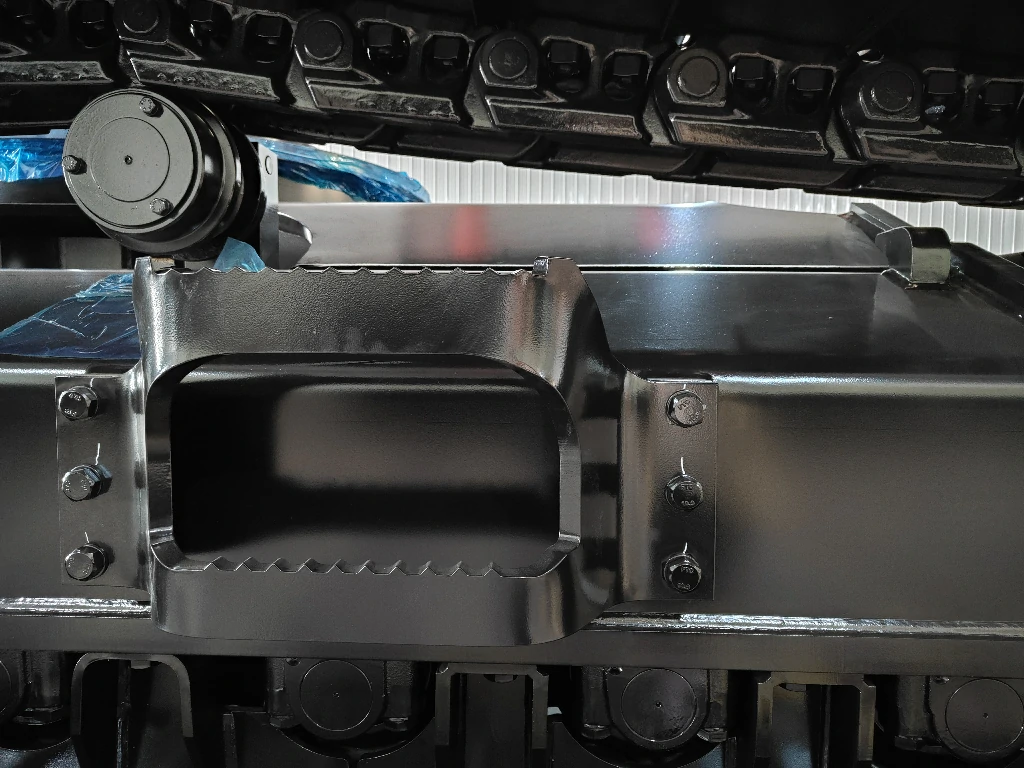
Rework cost on a custom chassis concentrates at the interface. The usual problems are not machining errors but items the drawing never defined: a flange with outer diameter but no bolt circle, hydraulic pressure and return sides reversed, dowel holes omitted, or a service door fouling the track beam. None of these are visible in the workshop; all appear at the customer's assembly line.
The sheet makes explicit the items each side assumed the other would confirm. Every line gets a value and a signature, and a completed sheet is the entry condition for releasing the 3D assembly drawing.
2. How the 18 parameters group
Group one is machine specification: model, maximum loaded weight, centre of gravity, duty cycle. Group two is load data: static load, dynamic factor, eccentric load, overturning moment. Group three is interface geometry: flange OD, bolt count and pitch circle, bolt specification, dowels, hydraulic port size and sides, slew bearing flange. Group four is environment and boundaries: ground type, temperature range, wading requirement, service envelope and transport limits.
Service envelope is new in the 2026 revision. It came from a crusher project where the chassis was entirely to specification but the customer's service door was blocked by 40 mm of track beam. Only a motion envelope check catches that class of problem.
3. Drawing formats and cadence
Two-dimensional interface drawings are accepted in DXF or DWG, three-dimensional assemblies in STEP or IGES. PDF drawings need measurable dimensions attached; a screenshot alone is not workable. Interface review comments return within one to two working days, and 3D modelling plus tooling design start only after both sides sign.
Two revisions are allowed: an initial version for quotation and concept, and a frozen version for production. Any change to the frozen version triggers a fresh lead-time assessment. That is stated on the sheet itself to avoid the assumption that a small change cannot affect delivery.
4. What it means for purchasing and engineering
For an OEM the sheet doubles as an internal sign-off template, collecting mechanical, hydraulic and service sign-off in one pass. For purchasing, the signed version becomes the reference for acceptance and responsibility boundaries later on.
Projects already in production are not forced to switch. New projects use the sheet by default from November 2026. Blank templates are available from our engineering team on request with no commercial conditions attached.
5. Four Parameter Groups (Extract)
| Group | Representative items | Common omission | Consequence |
|---|---|---|---|
| Machine spec | Loaded weight, centre of gravity | Model only, no weight | Under-sized chassis |
| Load data | Dynamic factor, overturning moment | No eccentric case | Weak frame torsion |
| Interface geometry | Bolt circle, hydraulic sides | Flange OD only | Will not fit on site |
| Environment | Service envelope, transport limit | Door swing | Interference after fit-up |
Key takeaways
- The 2026 sheet fixes 18 parameters into one signed checklist across five interface families.
- A new service envelope check catches motion interference rework before tooling starts.
- DXF/DWG for 2D and STEP/IGES for 3D; 3D modelling starts only after sign-off.
- Any change to the frozen sheet triggers a fresh lead-time assessment.
Further reading
OEM/ODM · Selection Guide · FAQ · Contact Us
Prepared by the MAGEON engineering team from custom project records and factory load-test data. Figures are engineering references; final selection should follow approved drawings and the actual duty spectrum.