 English
 简体中文

The most common point of disagreement in a selection conversation comes down to one word: tonnage. The same "20-tonne undercarriage" can mean very different things to different suppliers. This article first sets out the three tonnage conventions in use, then gives a working matching method so you can hold every supplier to the same measure.
1. Three Tonnage Conventions and How Far Apart They Sit
Three labelling conventions circulate in the industry, each referring to a different physical quantity:
| Convention | What it means | Relation to the machine | Relative size |
|---|---|---|---|
| Gross machine weight | Total weight of machine the chassis can carry, including the machine itself | Matches machine gross weight | Smallest of the three |
| Allowable total load | Mass permitted above the chassis | Matches payload above the chassis | Largest of the three |
| Per-track rating | Force carried by each track assembly | Matches local wheel-set design load | About half the total |
A concrete example: a 20-tonne excavator weighing 18 t empty and 22 t loaded. If the chassis is rated "20 tonnes" against gross machine weight, it is overloaded carrying a 22-tonne machine. If the same figure means allowable total load, there is margin. Identical numbers, opposite conclusions - which is why the convention must be on the quotation.
2. The Matching Method That Works
Work through it in this order:
Step one: establish the convention.Require the supplier to state which convention they quote against, and have it written into the quotation and technical agreement. This is the step most often skipped and the most likely to cause dispute.
Step two: calculate required capacity.Machine gross weight divided by the allowable total load figure gives the required ratio. A chassis rated at 25 t carrying a 22 t machine gives 1.14.
Step three: check the margin.The working baseline is a ratio of at least 1.2 to 1.3, allowing for fuel, hydraulic oil, dynamic loads and duty variation. The 1.14 above is tight and should be corrected upward.
Step four: add margin for duty.Three conditions must carry additional factor:
| Duty characteristic | Suggested ratio | Reason |
|---|---|---|
| Continuous work at high temperature | 1.3 - 1.4 | Seals age faster, clearances open up |
| Heavy impact loading | 1.4 - 1.5 | Instantaneous peaks far exceed static load |
| Gradient and mountainous work | 1.4 - 1.6 | Load concentrates at the drive sprocket |
3. Four More Things to Confirm Alongside Tonnage
Tonnage covers only one dimension of load capacity. Complete selection also requires:
1. Shoe width and ground pressure.Set by working surface, not by tonnage. In soft ground, a wider shoe delivers more than a heavier chassis. The calculation method is set out in Applications.
2. Track centre distance and gauge.These must match the machine frame exactly. They are interface parameters rather than selection parameters - the machine determines them, not the supplier.
3. Drive type and motor.Whether the drive is hydraulic, and which motor and reduction ratio, follows from the machine's work cycle. Fine flow control on an excavator and steady shock absorption on a rig call for entirely different matching.
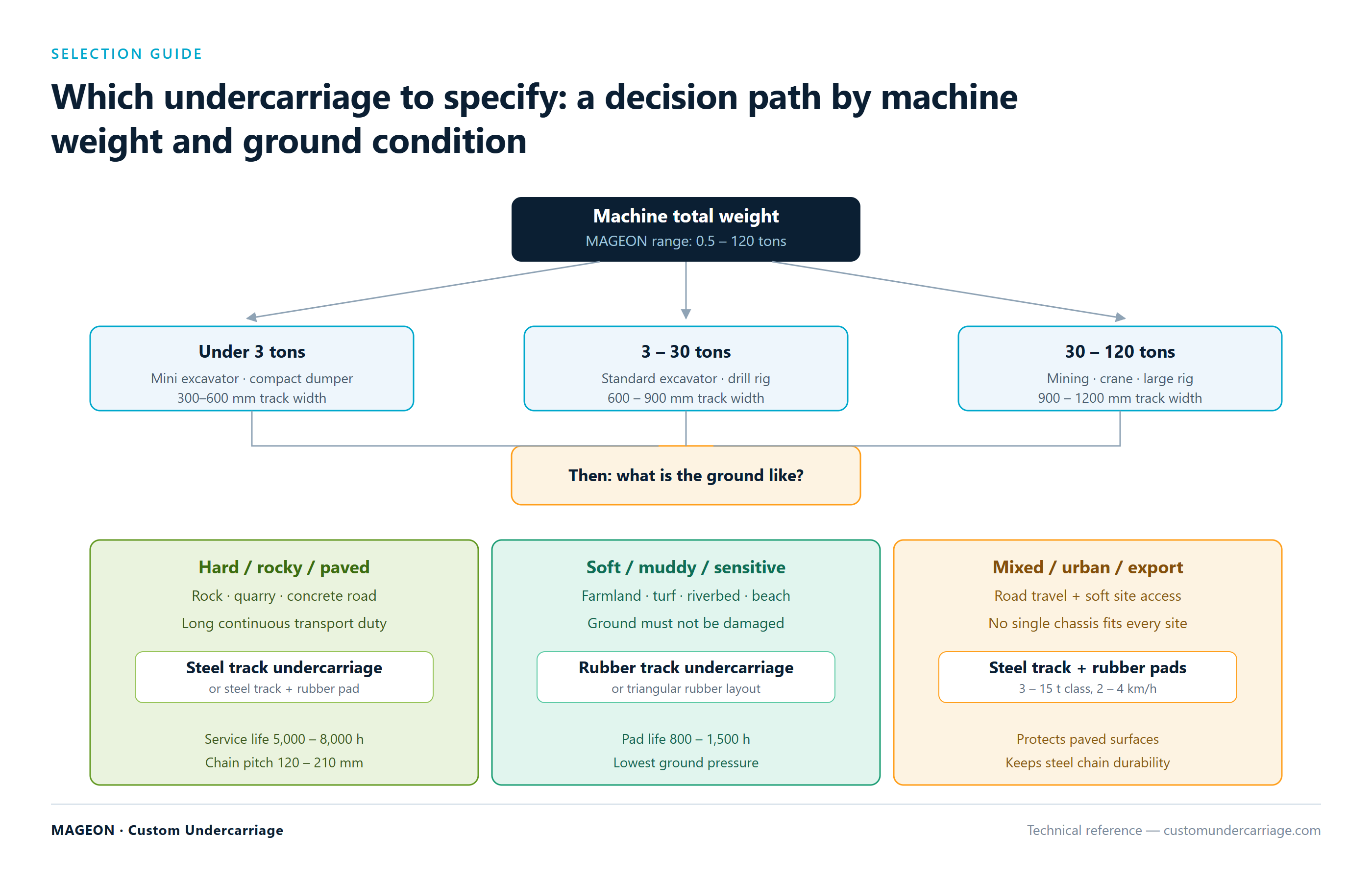
4. Track material.Steel versus rubber turns on paved surface requirements, ground protection needs and abrasive content. The decision criteria are compared under Steel Crawler Undercarriage and Rubber Crawler Undercarriage.
4. A Checklist You Can Use Before Approaching Suppliers
Compressing the above into a printable list for pre-enquiry self-check:
□ Machine type and model □ Empty weight □ Maximum gross weight □ Centre of gravity □ Maximum tractive effort □ Maximum gradient □ Working surface type and sand content □ Daily operating hours □ Ambient temperature and water exposure □ Track centre distance □ Gauge □ Measured frame flange dimensions □ Hydraulic port specification □ Whether paved surface operation is required
With this information complete, any supplier's proposal is built on a defensible basis rather than a standard configuration matched to habit. Parameter definitions are covered in Selection Guide, and tonnage-specific specifications can be compared under Products.