 English
 简体中文

What Is the Difference Between Steel and Rubber Track Undercarriage?
Steel and rubber track undercarriages use the same nine-component architecture — track shoe, track link, track roller, front idler, drive sprocket, hydraulic motor, travel gearbox, crossbeam and optional slewing bearing. The difference lies in the ground-contact layer. A steel track undercarriage runs on a forged, heat-treated chain with welded grouser bars, delivering a design life of 5,000–8,000 working hours. A rubber track undercarriage runs on steel-cord-reinforced rubber pads, delivering a pad life of 800–1,500 hours with a fraction of the ground pressure.
That single material choice cascades into traction, ground damage, service interval, noise and total cost of ownership. Getting it wrong is one of the most expensive mistakes an equipment manufacturer can make, because the chassis is the single most expensive component on a crawler machine and it is rarely the one the buyer thinks about.
What is the difference in ground contact between a steel and a rubber track undercarriage?
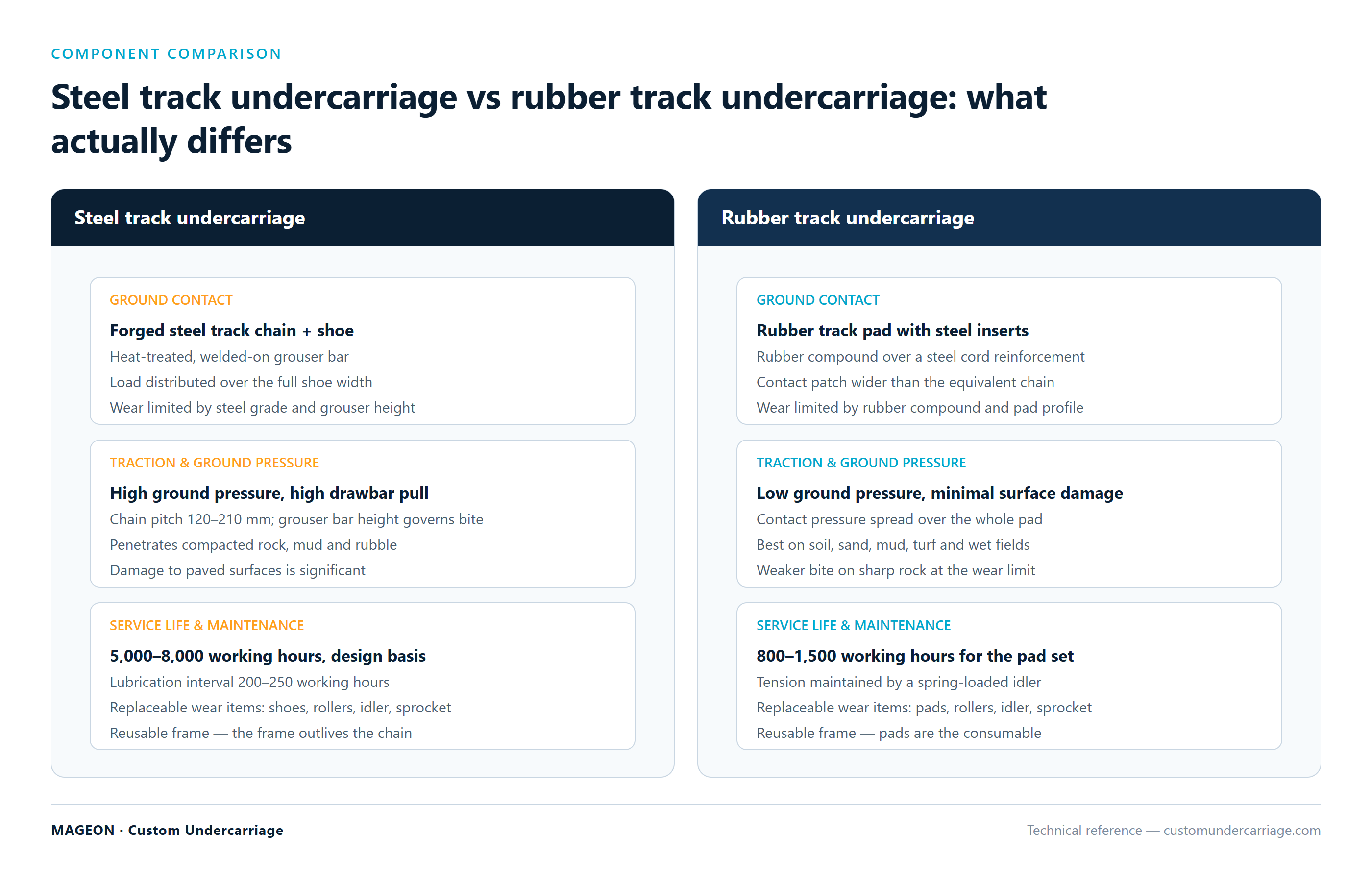
A steel track undercarriage transfers the machine's weight through a chain of forged steel track links, each terminated by a track shoe with a welded grouser bar. Contact is concentrated on the grouser bar, so the effective bearing area is a narrow line rather than a broad patch. The result is high ground pressure, which is exactly what you want on compacted rock but exactly what you do not want on a paved yard or a customer's field.
A rubber track undercarriage replaces the steel chain with a rubber pad reinforced by tensioned steel cords. The pad's full width becomes the contact surface, spreading the load across an area several times larger than the equivalent chain. MAGEON rubber track undercarriages for tracked dumpers, for example, are built at 800 mm track width, giving a contact patch that keeps ground pressure low enough for soft ground where a steel chassis would sink.
The third option sits between them: a steel track with rubber pads, where a steel chain carries the load and a bolt-on rubber pad protects the surface. This is the standard answer for machines that travel on public roads and then work on soft sites — the 3–15 ton class units MAGEON supplies for drilling rigs and mobile crushers use exactly this layout at 2–4 km/h travelling speed.
How does the traction and ground pressure differ between the two?
Traction on a steel track undercarriage comes from the grouser bar digging into the ground. Chain pitch typically runs 120–210 mm, and grouser bar height is the variable that governs how hard the track bites. A taller bar on a longer pitch produces higher drawbar pull and works well in mud, rubble and broken rock. The trade-off is that the same geometry that grips a quarry floor also tears up paving and softens the ground it crosses.
A rubber track undercarriage achieves traction differently. The rubber compound grips through friction over a much larger area rather than through mechanical penetration. This gives strong performance on soil, sand, mud, turf and wet agricultural fields, but it means less mechanical bite once the pad wears down on sharp angular rock. MAGEON sets rubber undercarriage travelling speed at 0–2 km/h for the compact hydraulic-drive class and 1–4 km/h for larger units — deliberately lower than a steel chassis on the same machine, because rubber does not tolerate the same speed against sharp edges.
Which one lasts longer and what does maintenance involve?
A steel track undercarriage is designed around a 5,000–8,000 working hour life on heavy-duty excavation. The frame is a welded Q345B structure and it routinely outlives the chain. Maintenance is scheduled rather than reactive: lubrication every 200–250 working hours, periodic inspection of track tension, and replacement of wear items — shoes, rollers, idler and sprocket — as they reach their wear limit. Because the frame survives, a chain replacement is a consumable cost, not a capital one.
A rubber track undercarriage inverts that relationship. The frame and running gear are again reusable, but the pad set is the consumable, with 800–1,500 working hours as the realistic planning figure. Tension is maintained by a spring-loaded idler rather than a hydraulic cylinder, which is simpler but means tension must be checked more often. The pads themselves are typically replaced in sections rather than as a complete set, and the steel cord reinforcement is the failure mode to watch — visible cord exposure means the pad must come off before the cord breaks and damages the sprocket.
What are the cost implications over the equipment lifetime?
Because MAGEON quotes on a per-project basis rather than a price list, the honest way to compare is total cost per operating hour rather than purchase price. A steel chassis costs more in the initial build and less per hour: the chain and shoes are wear items, and the frame is not consumed. A rubber chassis typically carries a lower initial cost and a higher per-hour cost once pads begin to be replaced on a regular cycle.
The two figures that flip the calculation are ground damage and downtime. If a machine works on a customer's field, on a rented yard, or on public roads, the ground damage caused by a steel chassis becomes a commercial liability that rarely appears on the equipment budget sheet. Rubber undercarriages exist partly to avoid that conversation.
How do I choose between them for a specific machine?
Start with machine weight, then with ground conditions, then with duty cycle. The selection path below is the same one MAGEON engineers apply during the requirement assessment step of a custom undercarriage project, and it covers the 0.5–120 ton range the company supplies.
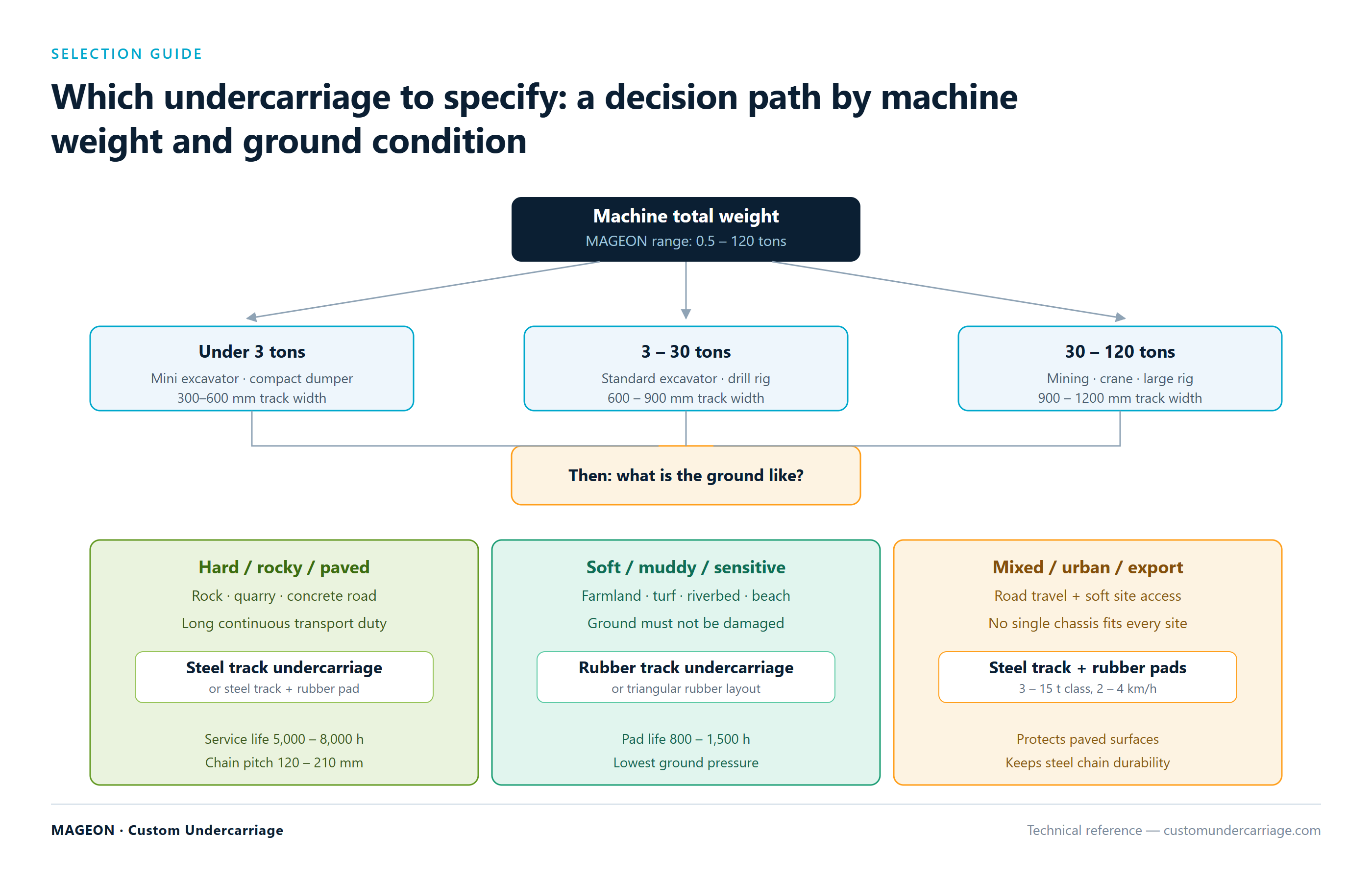
For a machine in the 3–30 ton class, MAGEON custom steel track chassis are typically specified at 600–900 mm track width, with hydraulic, electric or mechanical drive optional. For the 30–120 ton class used in mining and large crawler cranes, the band moves to 900–1200 mm. Below 3 tons, 300–600 mm is the norm.
One more variable deserves attention before you finalise the choice: the mounting interface. Whichever track material you select, the frame has to bolt to your upper structure. MAGEON customises the mounting flange, bolt pattern, drive shaft height and hydraulic interface to the customer's host structure, with one-to-one surveying against the existing equipment, so the chassis is a drop-in replacement rather than a rebuild.
What are the key components in each type of undercarriage?
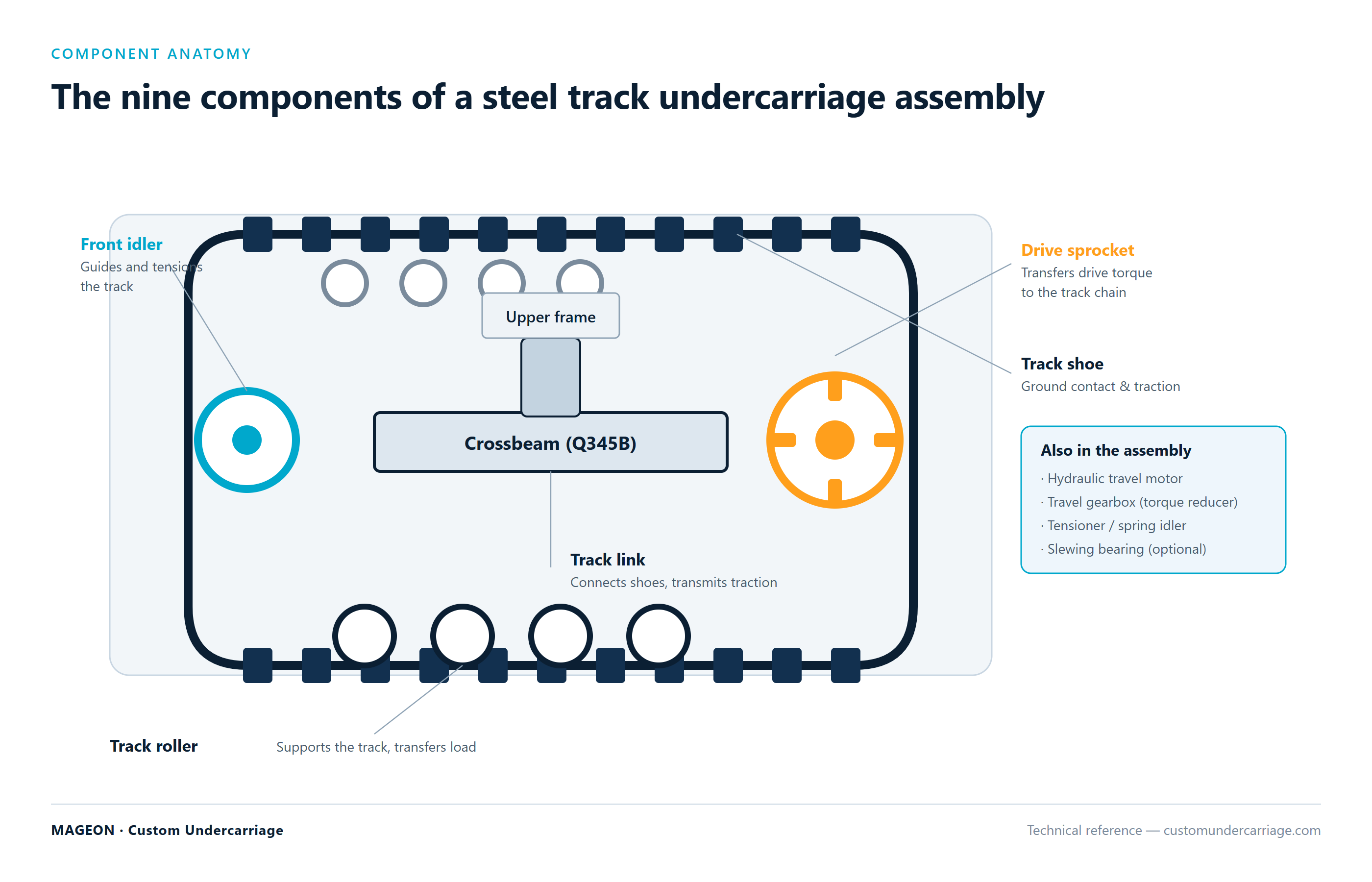
The component list is nearly identical between the two designs, which is why the material of the track layer is the decision that matters most. The table below lists the standard MAGEON component scope for a steel track undercarriage; the rubber variant substitutes the track chain with a rubber track and adds a tensioner in place of the idler adjustment.
| Component | Role |
|---|---|
| Track shoe | Provides ground contact and traction |
| Track link | Connects track shoes, transmits traction |
| Track roller | Supports the track and transfers machine load |
| Front idler | Guides and tensions the track |
| Drive sprocket | Transfers drive torque to the track |
| Hydraulic motor | Provides crawler movement |
| Travel gearbox | Reduces speed, increases torque |
| Crossbeam (Q345B) | Connects crawler assemblies to upper equipment |
| Slewing bearing (optional) | Enables 360° rotation of upper structure |
What information do you need to request a quotation?
Five data points let MAGEON produce a firm configuration and price for a custom crawler undercarriage: total machine weight and load distribution, the mounting interface dimensions including bolt pattern and drive shaft height, required travelling speed, the ground and duty conditions, and the drive configuration you need. Drawings in DXF, DWG or PDF are accepted and are the fastest route to an accurate quotation, but the five points above are enough to start.
Two commercial parameters are worth confirming up front. MAGEON's minimum order quantity is one set, so a prototype or a first production run does not carry a batch penalty. The standard lead time is approximately 20 days for one set and 30 days for two to three sets, with longer timelines negotiated for volume orders. All chassis ship with a one-year or 1,000-hour warranty and ISO 9001:2015 certification, with video inspection provided before dispatch.
Frequently asked questions
Is a rubber track undercarriage weaker than a steel track undercarriage?
No. A rubber track undercarriage is not structurally weaker — the load path runs through the steel frame, the steel-cord reinforcement and the steel sprocket in the same way a steel chassis does. What differs is the wear layer. Rubber performs differently on sharp rock, which is why MAGEON caps rubber undercarriage travelling speed at 0–2 km/h for the compact class and 1–4 km/h for larger units. On soil, sand, mud and turf, rubber is the stronger option because of its ground pressure profile, not weaker in any structural sense.
Can I convert an existing steel track machine to rubber?
Yes, and this is a common retrofit. The steel frame, rollers, idler and sprocket are retained and the track layer is changed to a rubber pad set with the appropriate pitch and width. This is only practical where the frame geometry and sprocket pitch already match a standard rubber configuration — a non-standard pitch or width means the whole running gear changes, and at that point a new undercarriage is often the more economical route. MAGEON customizes the mounting flange, bolt pattern, drive shaft height and hydraulic interface to the host structure, so a rubber conversion can be engineered as a drop-in replacement.
Which is cheaper to run over 10,000 hours?
It depends on ground conditions rather than on the chassis itself. On rock, quarry or long-haul transport duty, a steel track undercarriage usually costs less per operating hour because the 5,000–8,000 hour chain life means fewer consumable replacements. On soft ground where ground damage becomes a liability, or where machines travel frequently on paved surfaces, a rubber track undercarriage can be cheaper once ground restoration, surface damage claims and higher pad replacement frequency are counted. The comparison should be made per operating hour on your specific site, not on purchase price.
What is the minimum order quantity and lead time?
The minimum order quantity is one set. Estimated production time is 20 days for one set, 30 days for two to three sets, and to be negotiated for quantities above three sets. Standard packaging is a wooden pallet or wooden case, with FOB available at Shanghai, Ningbo or Shenzhen, and delivery by ocean shipping, air freight or land transport.
Can you supply the hydraulic motor and travel gearbox?
Yes. The drive configuration is specified per project — hydraulic, electric or mechanical drive are all available on the steel track undercarriage range. On some rubber undercarriage projects the customer supplies the travel motor, in which case MAGEON delivers the complete running gear and frame and leaves the motor interface to match. Both approaches are standard and both are confirmed at the requirement assessment stage before production begins.
How do I know the chassis will fit my machine?
Provide your drawings in DXF, DWG or PDF format and MAGEON will survey them one-to-one against the host structure, then confirm mounting flange dimensions, bolt pattern, drive shaft height and hydraulic interface before manufacturing. If drawings are not available, the five data points listed above are sufficient to begin, and the interface can be verified during the design stage. This verification is the single most important step in ordering a custom undercarriage, because it is the one that determines whether the chassis bolts on directly or requires modification to the upper structure.