 English
 简体中文

The document set required to specify a customised steel track undercarriage falls into three groups: the drawings that define the physical interface, the technical data that define the duty, and the commercial and quality documents that define the order. MAGEON accepts customer undercarriage drawings or technical specifications in DXF, DWG or PDF format, and supports both drawing-based and sample-based processing — which means the drawing is the fastest route but not a mandatory one. This article sets out exactly what to submit, and what MAGEON can work from when a complete drawing set is not available.
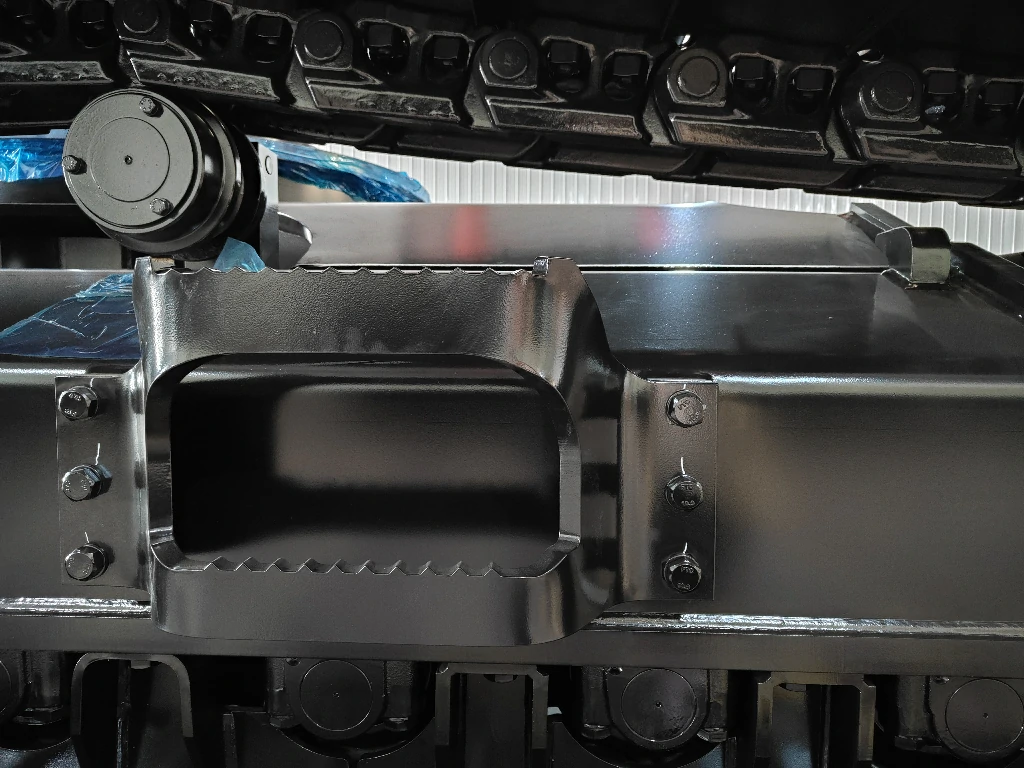
Which drawings are the most important to submit?
The single most important document is the mounting interface drawing of the host machine's upper structure. It should show the mounting flange outline with hole positions dimensioned from a stated datum, the drive shaft height above the mounting face, and the hydraulic port locations if the customer is supplying the travel motor. This drawing determines whether the chassis bolts on directly, and it is the item MAGEON surveys one-to-one against the physical machine before manufacturing.
The second document is the general arrangement drawing of the machine, showing overall dimensions, machine weight and the track envelope available for the undercarriage. Where the machine has been modified since delivery — a heavier boom, a larger tank, an added counterweight — the current dimensions matter, not the original catalogue values.
Third, and often overlooked, is the load data. A machine weight figure alone is not sufficient: MAGEON needs to know how that weight is distributed between the front and rear of the machine, because that distribution determines the load each crawler unit carries and therefore the frame, crossbeam, roller and sprocket specification. Where the machine lifts or pushes asymmetrically — a backhoe, a crane, a piling rig — the worst-case load case matters more than the static weight.
What technical data accompanies the drawings?
The duty data is what turns a set of drawings into a specification. MAGEON's requirement assessment covers five items: total machine weight and load distribution, the mounting interface dimensions including bolt pattern and drive shaft height, required travelling speed, the ground and duty conditions, and the drive configuration. Each of these is a design input for the steel track undercarriage, which is built to order from 1 to 60 tons with 200–500 mm track width and 1–4 km/h travelling speed.
Ground and duty conditions deserve particular attention because they are often under-specified. A statement such as "works in the quarry" does not tell the designer whether the surface is broken rock, hardpan, mud or a mix of all three, nor how many hours a day the machine operates, nor whether it travels on public roads between sites. The MAGEON rubber track undercarriage family for 1 to 15 tons and the steel track range for 1 to 60 tons are both selected around this working envelope, and a wrong reading of it produces a chassis that is technically correct and commercially wrong.
Where the customer is supplying the travel motor, the motor datasheet is a required document — displacement, maximum torque, port type and mounting flange — because the drive interface is designed around it. Where MAGEON supplies the drive, the machine's hydraulic system parameters are needed instead, so the motor and travel gearbox can be matched to the available flow and pressure.
| Document group | Specific items | Format |
|---|---|---|
| Interface drawings | Mounting flange, bolt pattern, drive shaft height, hydraulic ports | DXF, DWG, PDF |
| Machine data | Overall dimensions, machine weight, load distribution | Drawing and written specification |
| Duty data | Ground conditions, working hours, travel surfaces, required speed | Written specification |
| Drive data | Motor datasheet or hydraulic system parameters | Manufacturer datasheet |
| Sample (alternative) | Existing chassis for measurement and pattern reference | Physical sample or dimensioned photographs |
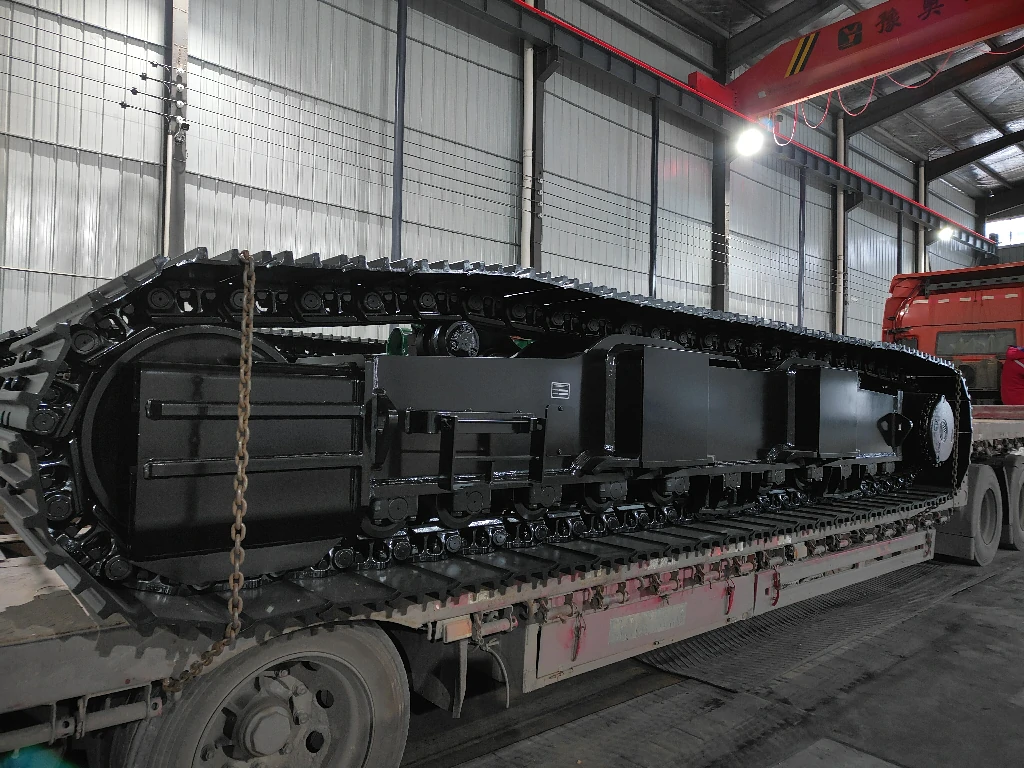
What quality and commercial documents accompany the delivery?
On the supplier side, MAGEON supplies a documented quality package with every customised steel track chassis. The production is carried out under an ISO 9001:2015 quality management system, and the package includes the factory inspection report, the material mill certificate for the high-strength Q345B steel used in the chassis beam, and video outgoing inspection before dispatch. A one-year or 1,000-hour warranty applies, covering the assembly as supplied.
On the customer's side, the documents that affect the order itself are the purchase specification, the drawing approval, and the agreed inspection and packing requirements. Packaging is standard wooden pallet or wooden case, and Incoterms are agreed at order stage — FOB is available at Shanghai, Ningbo or Shenzhen, with delivery by ocean shipping, air freight or land transport. Where the project requires a third-party inspection or a specific certificate of conformity, that should be stated at enquiry rather than after the build slot is booked.
What if the drawing set is incomplete or unavailable?
A complete drawing set is the best case, not the entry requirement. MAGEON supports sample-based processing, so an existing chassis can be used as the measurement reference when the original supplier's drawings are no longer available — a common situation on machines several years into their service life. A dimensioned photographic survey of the mounting flange, plus the machine's weight and a tape measure, is enough to begin a configuration and price discussion.
What MAGEON will not do is treat an unverified dimension as confirmed. Any interface dimension that cannot be established from customer data or physical measurement is flagged during the design stage and confirmed in writing before manufacturing, and the physical fit check during assembly is the final gate. Video outgoing inspection is provided before dispatch, so the assembled chassis can be reviewed against the interface confirmation while it is still on the factory floor.
How does the submission process run from enquiry to production?
Enquiry and technical review run in parallel. MAGEON's engineering team replies within one working day on a technical enquiry, and the requirement assessment that follows resolves the machine weight, installation dimensions, travel speed, working conditions and drive configuration into a single configuration and price. Once the configuration and the interface confirmation are approved, production begins, with the standard lead time of approximately 20 days for one set and 30 days for two to three sets. Longer timelines are negotiated for volume orders, and the minimum order quantity is one set, so a first prototype does not carry a batch penalty.
Submitting a coherent document set at the first enquiry does not shorten the manufacturing schedule — those 20 days are production time — but it removes the approval loop from the front of it, which is where most custom undercarriage projects actually lose their time.
Frequently asked questions
Do I need CAD drawings, or will photographs work?
CAD drawings in DXF, DWG or PDF are preferred because the dimensions can be read directly rather than scaled from an image. Photographs work as a starting point, but they need at least one stated dimension per view to be scaled against — typically the flange length — otherwise the bolt pattern can only be estimated, and an estimated bolt pattern is not good enough to cut steel against. MAGEON supports sample-based processing, so a physical sample of the existing chassis is often more useful than photographs.
What is the single most important document for a drop-in replacement?
The mounting interface drawing of the upper structure, with the flange outline, hole positions dimensioned from a stated datum, and the drive shaft height above the mounting face. That single document determines whether the chassis bolts on directly. Everything else about the undercarriage can be designed around; the interface is the one thing that cannot, because it is fixed by the machine above.
Why do you need load distribution and not just machine weight?
Because an undercarriage has to carry the machine's weight unevenly. A backhoe or a piling rig places a large share of its mass at the front during operation, and the static weight figure hides that. Designing to the static figure alone under-specifies the front crossbeam and the rollers on that unit. MAGEON asks for the load distribution and the worst-case load case so the frame is sized for how the machine actually works, not for how it sits on the delivery ramp.
Can MAGEON work from our own CAD files of the machine rather than the undercarriage?
Yes, and this is often the practical situation. A machine general arrangement drawing showing the mounting face, the frame rails and the available envelope is workable, provided the flange hole pattern is either shown or physically measurable. MAGEON then surveys against the host structure one-to-one and issues an interface confirmation for approval, so the customer approves a document that reflects the real machine rather than the drawing alone.
What does MAGEON supply with the chassis?
Every customised steel track chassis ships with a one-year or 1,000-hour warranty, production under ISO 9001:2015 quality management, a factory inspection report, a material mill certificate for the Q345B chassis beam material, and video outgoing inspection before dispatch. Packaging is a wooden pallet or wooden case, and FOB is available at Shanghai, Ningbo or Shenzhen with delivery by sea, air or land.
How long does the whole process take, from enquiry to delivery?
Approximately 20 days for one set and 30 days for two to three sets from the point production is approved, with longer timelines negotiated for volume orders. The requirement assessment and interface confirmation happen before that, and their duration depends mainly on how completely the customer's information is supplied at the first enquiry. A complete document set typically returns a configuration and price within one working day of the enquiry.