 English
 简体中文
简体中文
The steel crawler undercarriage is the single most expensive component in heavy machinery — industry data shows that undercarriage maintenance accounts for approximately 50% of total tracked equipment maintenance costs, non-standard undercarriage annual downtime exceeds 30 days, and O&M costs typically exceed 15% of total equipment value. How to control this cost within a reasonable range through systematic lifecycle management is a question every equipment manager must answer. As a globally leading manufacturer of Custom Tracked Chassis, MAGEON draws on hundreds of actual matching project experiences covering the full load range of 0.5 to 120 tons to provide a systematic analysis of steel crawler undercarriage lifecycle management from selection, installation, operation, maintenance to repair and disposal — helping equipment managers establish a scientific “prevention-first, tiered maintenance” management system.
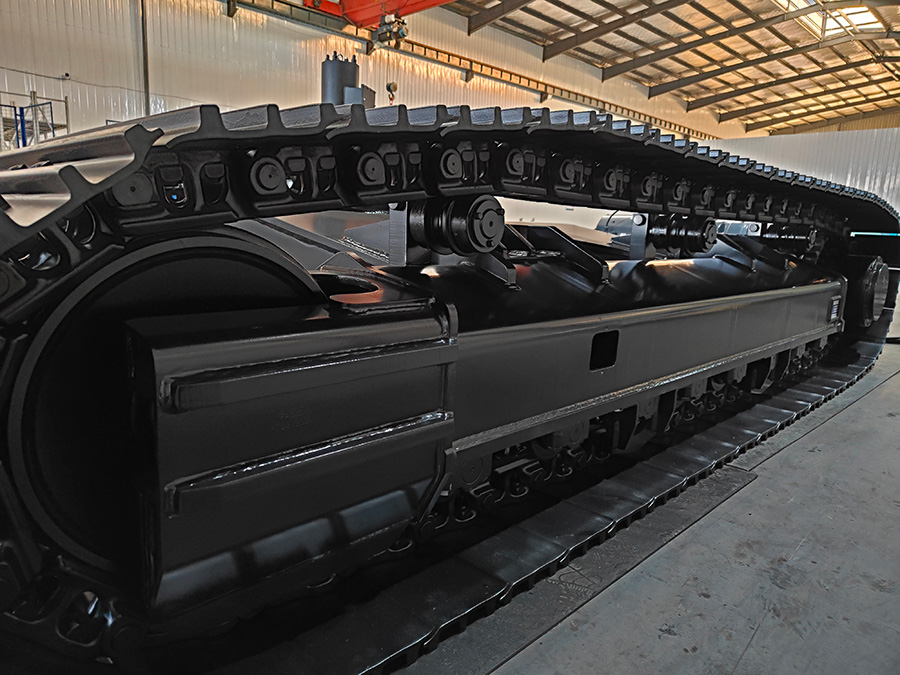
1. Steel Crawler Undercarriage Structural Features and Application Scenarios
1.1 Core Structural Composition
A steel crawler undercarriage consists of drive sprockets, idlers, track rollers, carrier rollers, and track shoes, connected through high-strength steel welding or bolting, with impact-resistant and wear-resistant characteristics. This structure is known as the “four wheels one track” — the foundation of the travel system for tracked equipment.
| Component | Function | Quantity (Per Side) | Key Failure Mode |
|---|---|---|---|
| Drive Sprocket | Engages track chain to transmit power | 1 per travel motor | Tooth wear, tooth root cracks |
| Idler | Guides track direction, maintains tension | 1 | Seal failure, bearing seizure |
| Track Roller | Bears equipment weight, distributes load | 5-10 | Floating seal leak, roller depression |
| Carrier Roller | Supports upper track run, prevents sag | 1-2 | Poor rotation, bearing noise |
| Track Shoe | Ground contact, provides traction | Full track | Grouser wear, plate cracks, deformation |
1.2 Core Technical Parameter Characteristics
| Parameter | Typical Range | Selection Impact |
|---|---|---|
| Track Shoe Width | 300 – 1,100mm | Wider = lower ground pressure, better soft soil flotation |
| Track Pitch | 101 – 260mm | Larger = higher load capacity, but larger turning radius |
| Ground Pressure | 0.3 – 1.2 kg/cm² | Soft soil conditions require below 0.5 |
| Track Sag | 10 – 30mm | Too loose causes derailment, too tight increases power loss |
| Operating Temperature | -25℃ to +55℃ (rubber tracks) | Steel tracks have no special temperature limit (depends on grease) |
1.3 Core Application Scenarios
Mining: Gravel roads, steep slopes, high-abrasion conditions
Forestry Machinery: Muddy forest land, slopes, root obstacles
Special-Purpose Vehicles: Heavy transport, extreme terrain
Rotary Drilling Rig Chassis: Stability requirements during deep-hole drilling
Drilling Rig Undercarriage: Mobility requirements on complex field terrain
2. Selection Stage: The Starting Point of Lifecycle Management
2.1 Three-Step Selection Process
Step 1: Identify Operating Scenario
Where does it operate? (Mine/Job site/Farmland/Tunnel/Urban)
What are the ground conditions? (Rock/Soft soil/Mud/Slope/Paved)
Does it require frequent relocation?
Step 2: Determine Load & Dimensions
What is the total equipment weight?
What are the mounting interface requirements?
Is transport width restricted?
Step 3: Match Technology & Cost
Choose Steel Crawler Undercarriage or Rubber Track Undercarriage?
Is Telescopic Crawler Undercarriage function needed?
Is total lifecycle cost within budget?
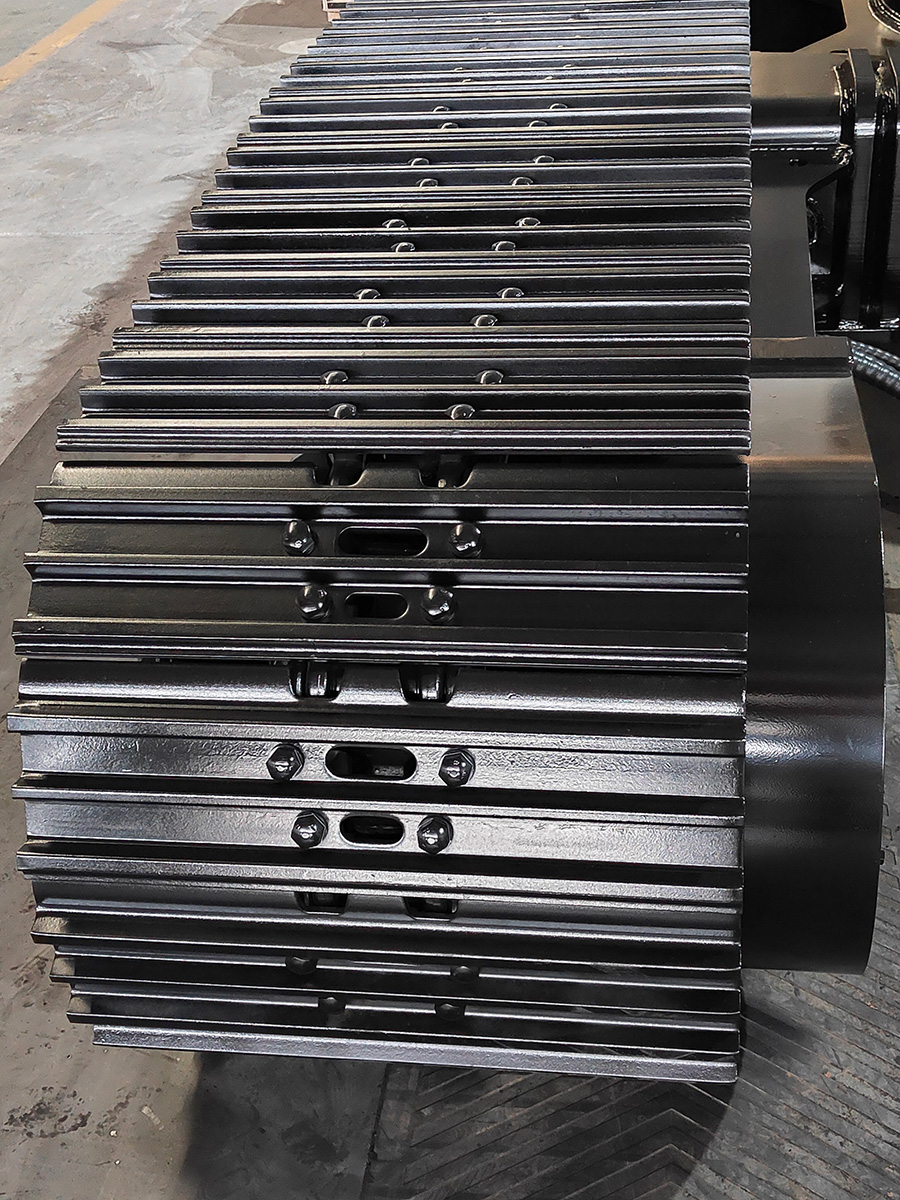
2.2 Selection Reference: Recommended Undercarriage Specifications by Equipment Weight
| Equipment Weight | Recommended Rated Capacity | Recommended Pitch | Recommended Track Width |
|---|---|---|---|
| 3-5 tons | 4-6 tons | 150mm | 300-350mm |
| 5-10 tons | 6-12 tons | 150-180mm | 350-400mm |
| 10-20 tons | 12-24 tons | 180mm | 400-500mm |
| 20-30 tons | 24-36 tons | 180-210mm | 500-600mm |
| 30-50 tons | 36-60 tons | 210mm | 600mm+ |
| 50+ tons | 60+ tons | 216mm+ | Custom width |
MAGEON Selection Recommendation: Load capacity calculation should follow the principle of “rated capacity ≥ equipment weight × 1.2,” reserving 20% safety margin for dynamic loads under heavy-load, climbing, and impact conditions.
2.3 Key Control Points During Installation
| Installation Step | Key Control Point | Common Issue | Prevention |
|---|---|---|---|
| Mounting Interface Match | Upper structure and chassis mounting holes aligned | Hole deviation causes uneven bolt stress | Verify drawings before installation, use positioning fixtures |
| Initial Track Tension | Adjust to 10-30mm sag per manual | Too tight or too loose causes initial abnormal wear | Use tension cylinder for precise adjustment, keep both sides consistent |
| Hydraulic Line Connection | Travel motor line fittings tightened | Oil leak causes weak travel | Tighten to torque spec, perform pressure test |
| Grease Application | Apply grease to rollers, idlers, carrier rollers | Insufficient lubrication causes bearing dry friction | Use specified grease type, apply until overflow |
3. Operation Stage: Correct Operating Habits Are the Best Maintenance
3.1 Daily Operation Standards
| Operation Item | Standard Requirement | Consequence of Violation |
|---|---|---|
| Travel Speed | Select appropriate speed by road condition | High-speed travel on rough terrain causes link impact fracture |
| Steering | Slow down before turning | Sharp turns accelerate track shoe and sprocket wear |
| Slope Operation | Avoid lateral travel | Side overturning risk |
| Travel Under Load | Avoid long-distance travel under load | Track roller and shoe overload |
| Continuous Operation | Stop and check oil temperature every 2 hours | High oil temperature causes floating seal ageing and leakage |
3.2 Five Major Operation Taboos
| Operation Taboo | Damage Mechanism | Consequence | Correct Practice |
|---|---|---|---|
| Sharp turns | Severe lateral friction | Accelerated shoe and sprocket wear | Slow down before turning |
| Pivot turns | One track bears full weight | Roller and link overload | Avoid on hard surfaces |
| High-speed on rough terrain | High-frequency link impact | Link fracture, sprocket tooth breakage | Reduce speed, pass smoothly |
| Prolonged travel | Sustained oil temperature rise | Floating seal ageing and leakage | Stop every 2 hours |
| Neglecting tension checks | Improper tension causes abnormal wear | Derailment or accelerated wear | Check before each shift |
4. Maintenance Stage: Establishing a Tiered Maintenance System
4.1 “Prevention-First, Tiered Maintenance” Management System
MAGEON recommends establishing a three-tier maintenance system per GB/T 3821-2019:
| Maintenance Level | Interval | Core Content | Executor |
|---|---|---|---|
| Level 1 (Daily) | Per shift | Clean chassis, check tension, check leaks, lubricate slewing ring | Operator |
| Level 2 (Periodic) | Every 250 hours | Four wheels one track wear check, comprehensive cleaning, reducer oil level | Maintenance personnel |
| Level 3 (Comprehensive) | Quarterly/Annually | Comprehensive chassis inspection, data recording, wear trend analysis | Professional technicians |
4.2 Daily Inspection and Maintenance Standards
(1)Track Tension Adjustment
Regularly check the engagement clearance between track and drive sprocket. Too loose causes derailment; too tight increases power loss. Adjust to 10-30mm sag via the tensioning device.
| Road Condition | Tension Strategy | Technical Principle |
|---|---|---|
| Soft soil/pebbles | Loosen appropriately (≈30mm) | Increase contact area, reduce ground pressure |
| Flat hard surface | Tighten appropriately (10-15mm) | Reduce sag, improve traction efficiency |
| Rough gravel | Medium tension (15-25mm) | Balance cushioning and traction |
(2)Key Component Wear Monitoring
Track roller bearings, sprocket teeth, and other wear parts require focused inspection. Monthly visual inspection — replace or repair promptly upon abnormal noise, looseness, or excessive wear. Industry data shows规范 inspection can reduce undercarriage failure rates by 40%.
(3)Chassis Cleaning and Lubrication
Clean mud and debris from the chassis after each shift. Rotating parts such as track rollers and idlers require grease application every 50 hours. In low-temperature environments (e.g., -30℃), use low-temperature grease (such as -30℃ grade lithium grease) to ensure good fluidity.
4.3 Seasonal Maintenance Priorities
| Season | Maintenance Priority | Specific Measures |
|---|---|---|
| Winter | Check track shoe frost-crack resistance | Replace with manganese steel tracks if necessary; use -30℃ low-temp grease |
| Summer | Enhance hydraulic system cooling | Prevent high oil temperature causing seal ageing |
| Rainy Season | Increase chassis cleaning frequency | Prevent mud/water ingress into floating seals |
| Pre-Winter/Summer | Seasonal maintenance | Comprehensive inspection, replace grease for season |
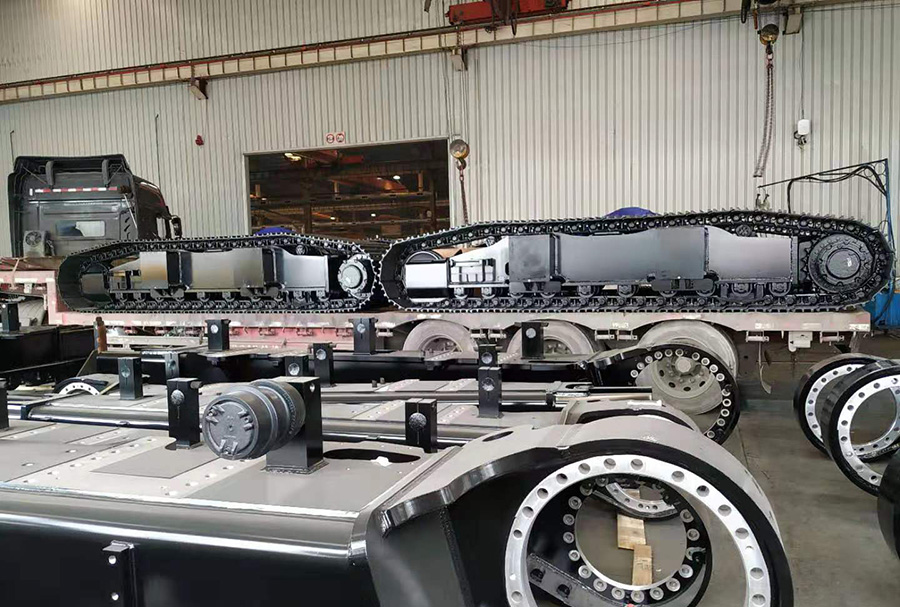
5. Repair Stage: The Last Mile of Undercarriage Life Extension
5.1 Track Shoe Crack Repair
When steel track shoes develop cracks, welding repair or reinforced shoe replacement can be used. Industry practice shows that the “weld-then-harden” process can increase repaired part service life to 1.5 times the original design. Additionally, hardfacing-repaired wear parts can achieve 80%-90% of new part remaining life at only 30% of new part cost.
MAGEON Repair Process Points:
Water toughening treatment for high-manganese steel before welding to prevent weld cracks
Post-weld stress relief annealing to prevent secondary cracking
Precise temperature and time control during hardening to restore 32-38HRC hardness
5.2 Chassis Deformation Correction
For long-term heavy-load deformation, use cold correction with specialised tooling — avoid flame correction which degrades steel properties. After correction, re-inspect track symmetry to ensure smooth travel.
Post-Correction Inspection Items:
Track symmetry (deviation ≤5mm)
Track frame flatness (deviation ≤3mm/m)
Travel straightness (deviation ≤50mm over 50m)
6. Full Lifecycle Cost Management
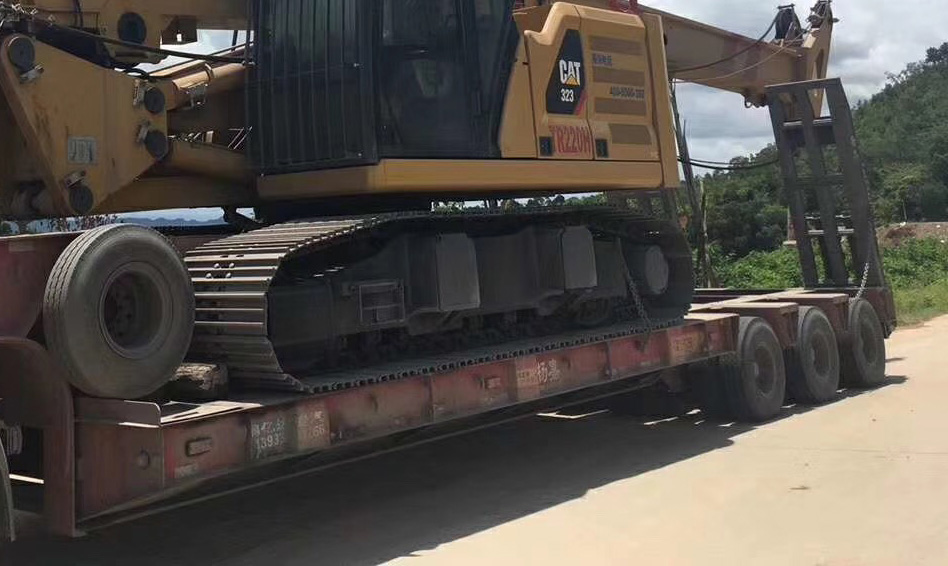
6.1 Maintenance Economics Analysis
| Maintenance Input | Maintenance Cost | Consequence Without Maintenance | Repair Cost | Cost Ratio |
|---|---|---|---|---|
| Daily cleaning (5 min) | ≈0 | Floating seal leak → bearing burnout | Track roller replacement + downtime | 1:10+ |
| Tension adjustment by road | ≈0 | Link fracture → derailment | Track chain assembly replacement | 1:20+ |
| 250H four wheels one track check | Labour cost | Sprocket tooth breakage → skipping | Sprocket replacement + link damage | 1:5+ |
| 50H joint lubrication | Grease cost | Bearing dry friction → seizure | Track roller assembly replacement | 1:8+ |
6.2 Lifecycle Cost Optimisation Strategies
| Management Stage | Cost Control Measure | Expected Effect |
|---|---|---|
| Selection | Precise selection by conditions, 20% safety margin | Avoid under- or over-configuration |
| Installation | Strict standards, pressure testing | Reduce initial failure rate |
| Operation | Follow operating standards, avoid taboos | Reduce abnormal wear |
| Maintenance | Tiered system, wear data recording | Preventive replacement, avoid chain failures |
| Repair | Weld-then-harden process, cold correction | Repaired parts at 80-90% life, 30% cost |
Core Conclusion: Establishing a scientific lifecycle management system can reduce the total lifecycle cost of a steel crawler undercarriage by 30%-40%.
6.3 Global Undercarriage Market Trends
According to Hengzhou Chengsi research, the global steel crawler undercarriage revenue was approximately 48.77 billion RMB in 2025, projected to approach 68.35 billion RMB by 2032, with a CAGR of 4.9% for 2026-2032. In 2025, steel crawler undercarriage production reached 902,000 units, with an average selling price of $7,480.6 per unit.
7. Frequently Asked Questions (FAQ)
Q1: What is the standard track sag for a steel crawler undercarriage? How is it adjusted?
A: The standard track sag is typically 10-30mm, with specific values per the equipment manual. Too loose causes derailment; too tight increases power loss and accelerates pin wear. On soft soil or pebbles, loosen to approximately 30mm to increase contact area; on flat hard surfaces, tighten to 10-15mm for better traction. Adjustment is made via the tension cylinder, ensuring both tracks have consistent sag.
Q2: How often should grease be applied to a steel crawler undercarriage?
A: Rotating parts such as track rollers and idlers require grease application every 50 hours. In low-temperature environments (e.g., -30℃), use low-temperature grease (such as -30℃ grade lithium grease) to ensure good fluidity. Apply the specified grease type until overflow, ensuring the bearing cavity is fully packed.
Q3: How are cracked track shoes repaired? What is the repaired life?
A: Steel track shoe cracks can be repaired using the weld-then-harden process. The process includes: water toughening treatment for high-manganese steel before welding; post-weld stress relief annealing; precise temperature and time control during hardening to restore 32-38HRC hardness. Industry practice shows repaired track shoes achieve 1.5 times the original design life, while hardfacing-repaired parts achieve 80%-90% of new part remaining life at only 30% of new part cost.
Q4: How is chassis deformation corrected? What items are inspected after correction?
A: For long-term heavy-load deformation, use cold correction with specialised tooling — avoid flame correction. After correction, re-inspect: track symmetry (≤5mm), track frame flatness (≤3mm/m), and travel straightness (≤50mm over 50m) to ensure smooth travel.
Q5: What winter maintenance does a steel crawler undercarriage require?
A: Winter maintenance priorities include: ①Check track shoe frost-crack resistance, replace with manganese steel tracks if necessary; ②Use -30℃ low-temperature grease; ③Pre-heat hydraulic system before operation; ④Increase chassis cleaning frequency to prevent frozen mud accelerating wear.
Q6: What is the “prevention-first, tiered maintenance” system?
A: It is the chassis management system recommended by MAGEON per GB/T 3821-2019. The three-tier system includes: Level 1 (Daily) — clean chassis, check tension and leaks per shift; Level 2 (Periodic) — check four wheels one track wear every 250 hours, clean chassis, check reducer oil level; Level 3 (Comprehensive) — quarterly comprehensive inspection, data recording to form maintenance files.
Q7: Which operating habits shorten undercarriage life?
A: Five major taboos: ①Sharp turns — severe lateral friction accelerating shoe and sprocket wear; ②Pivot turns — one track bears full weight, overloading rollers and links; ③High-speed travel on rough terrain — high-frequency link impact causing fracture; ④Prolonged continuous travel — oil temperature rise causing seal ageing and leakage; ⑤Neglecting tension checks — causing derailment or abnormal wear.
Q8: What undercarriage parts does MAGEON supply?
A: MAGEON supplies a complete range of Undercarriage Parts, including: track chains (links, pins, bushings), track shoes, drive sprockets, track rollers, idlers, carrier rollers, track frames, tensioning systems, floating seals, and more. All components are manufactured to MAGEON‘s own technical standards and are compatible with mainstream host brands.
Q9: Can MAGEON customise dedicated chassis for rotary drilling rigs?
A: Yes. The Rotary Drilling Rig Chassis is one of MAGEON’s core products. MAGEON provides 10-100 ton heavy-duty chassis specifically designed for rotary drilling rigs, equipped with large-diameter slewing bearings, reinforced track frames, and high-strength track chain designs. The Drilling Rig Undercarriage also covers 0.5-50 ton load ranges, precisely matched to rig type and operating terrain.
Q10: How much cost savings can a lifecycle management system deliver?
A: MAGEON‘s data analysis based on hundreds of actual projects shows: spending 5 minutes daily cleaning undercarriage debris can prevent floating seal leakage causing bearing burnout, with a cost ratio of approximately 1:10+; adjusting tension by road conditions can prevent link fracture and track derailment, with a cost ratio of approximately 1:20+. Establishing a scientific lifecycle management system can reduce the total lifecycle cost of a steel crawler undercarriage by 30%-40%.
8. About MAGEON
MAGEON is dedicated to delivering high-quality Steel Crawler Undercarriage and Rubber Track Undercarriage custom solutions to the global heavy machinery industry. With customisation capabilities covering the full load range of 0.5 to 120 tons and hundreds of actual matching project experiences, we tailor travel-drive solutions for every customer’s specific operating conditions, providing full lifecycle services from selection to maintenance.
Our Core Capabilities:
Load Range: Full-load custom solutions from 0.5 to 120 tons
Undercarriage Types: Steel crawler undercarriage, rubber track undercarriage, telescopic crawler undercarriage, dedicated rotary drilling rig chassis
Core Applications: Rotary drilling rigs, exploration drilling rigs, excavator conversions, mining equipment, agricultural machinery, and more
Parts Supply: Complete range of Undercarriage Parts including track chains, track shoes, drive sprockets, track rollers, idlers, and carrier rollers
Management Support: Lifecycle management consulting, installation guidance, maintenance training, fault diagnosis, spare parts support
From design to delivery, MAGEON stands for exceptional quality and dependable service, helping your equipment perform efficiently on the most challenging terrains.