 English
 简体中文

Yes. At MAGEON the mounting interface is treated as a designed component of the crawler undercarriage, not as an adapter. MAGEON customises the mounting flange, bolt pattern, drive shaft height and hydraulic interface to the customer's host structure, surveying the existing equipment one-to-one so the delivered chassis is a drop-in replacement for the unit it replaces. For a supplier building customised steel track undercarriages from 1 to 60 tons across drilling rigs, crushers, excavators, piling machines, lifting equipment and mining machinery, non-standard mounting is a routine engineering task rather than a special request.
This article explains what makes an interface standard or non-standard, how MAGEON captures the survey data, and what you need to submit to get an accurate interface confirmation before production begins.
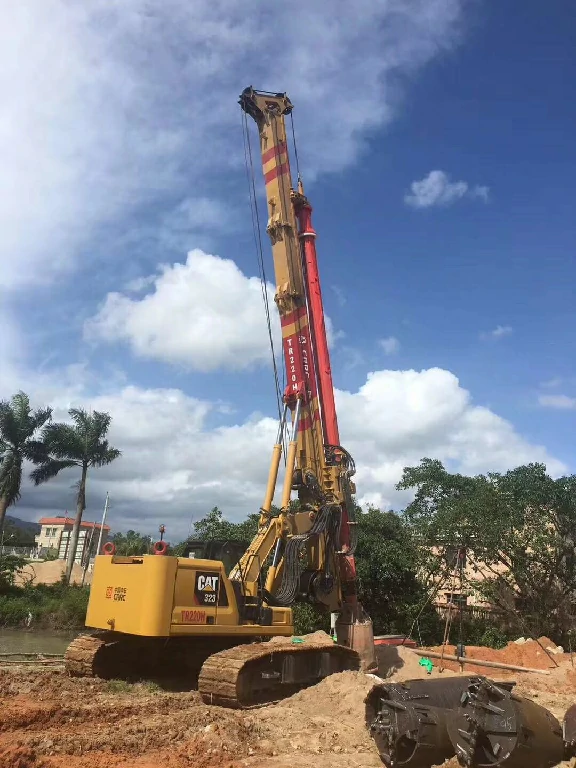
What actually counts as the mounting interface of a crawler undercarriage?
The mounting interface is the set of dimensions that governs whether a chassis physically and hydraulically connects to the machine above it. In practice it breaks into four groups, and all four have to match for the undercarriage to bolt on without rework.
The first group is the frame interface — the crossbeam and upper frame dimensions, the width across the crawler units, and the centre distance between them. This determines whether the chassis footprint fits inside the machine's frame rails and whether the tracks sit at the correct track gauge for the machine's stability and rollover limits.
The second group is the bolt pattern: hole diameter, number of holes, hole spacing, and the bolt circle or rectangular grid arrangement on the mounting flange. This is where non-standard specifications usually originate, because every machine builder has historically bolted its own upper frame to its own chassis supplier's frame, and those patterns are not standardised across the industry.
The third group is the drive interface — the drive shaft height above the mounting surface, the shaft diameter and keyway or spline specification, and the axial position of the motor relative to the sprocket. The fourth is the hydraulic interface, covering the travel motor's port type and orientation, hose routing, and whether the customer supplies the motor and gearbox or accepts MAGEON's.
Why do non-standard interfaces occur in the first place?
Three situations generate most of them. The first is retrofitting a chassis onto a machine whose upper structure was designed for a different undercarriage supplier — common when replacing a failed original chassis years after the machine was built, and the reason MAGEON accepts customer drawings as the primary input.
The second is a machine that has itself evolved. A drilling rig that started as a 12-ton unit gets a larger mast, a deeper box, a heavier drill carriage, and reaches 18 tons. The upper frame changes, the load distribution changes, and the undercarriage that was adequate at 12 tons is now undersized. Replacing the chassis rather than the whole machine is often the economical route, and it requires a non-standard interface to be engineered from the current drawings.
The third is genuinely novel machinery — a bespoke trenchless pipe roof rig, a custom screening plant, a specialised trenching machine — where no standard chassis exists and the interface is designed from first principles alongside the machine.
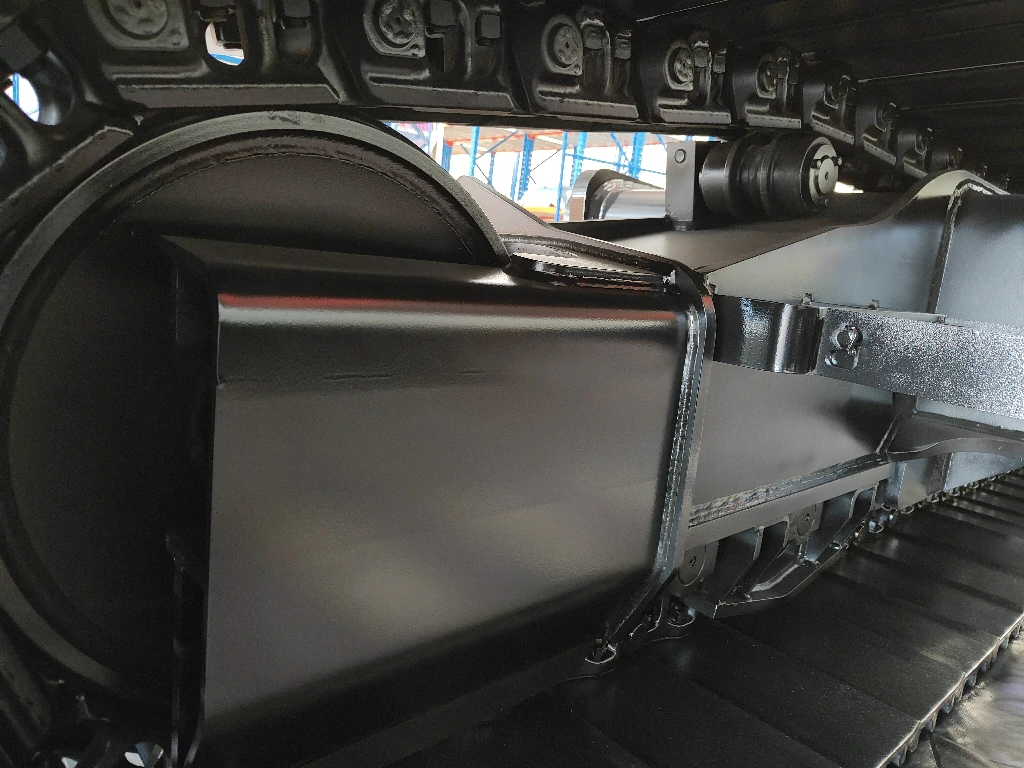
How does MAGEON confirm the interface before manufacturing?
The process begins with customer drawings. MAGEON accepts undercarriage drawings or technical specifications in DXF, DWG or PDF format, and supports both drawing-based and sample-based processing. The drawings are surveyed one-to-one against the host structure, which means the actual interface dimensions on the machine are read rather than assumed from a catalogue.
From the survey, MAGEON confirms mounting flange dimensions, bolt pattern, drive shaft height and hydraulic interface, and issues an interface confirmation for approval before any material is cut. For a customised steel track undercarriage this is the step that protects the schedule: it is far cheaper to adjust a drawing than to fabricate a frame that does not bolt to the machine, and the lead time of approximately 20 days for a single set leaves no room for a rework loop.
Beyond the four interface groups, the same survey captures the data that determines the chassis itself — machine weight and load distribution, track width, travelling speed, and whether a slewing bearing rotary system is required for 360° upper structure rotation in confined working conditions.
Which MAGEON products are built with a customised interface?
Every MAGEON undercarriage is built to order rather than pulled from stock, so the interface is custom by default. The range spans the 1–60 ton steel track undercarriage with 200–500 mm track width, the same platform with an integrated slewing bearing for 360° rotation, the 3–15 ton rubber-padded steel track undercarriage for drilling rigs and mobile crushers, and the rubber track undercarriage family from 1 to 15 tons.
| Interface element | What MAGEON confirms | Typical source of the data |
|---|---|---|
| Mounting flange | Outer dimensions, thickness, flatness | Upper frame drawing, physical survey |
| Bolt pattern | Hole diameter, count, spacing, grid arrangement | Frame drawing or template check |
| Drive shaft | Height above mount, diameter, keyway or spline | Motor datasheet, shaft measurement |
| Hydraulic interface | Port type, orientation, hose routing, motor supply responsibility | Hydraulic schematic, site check |
| Structural geometry | Track width, track gauge, overall dimensions | Machine weight and stability requirement |
What if I do not have drawings?
A drawing is the fastest route, but it is not a precondition. A physical sample of the existing chassis or a set of measurements — flange length and width, hole positions measured from a datum, drive shaft height taken from the mounting face, and the machine's total weight — is enough for MAGEON to begin the configuration and price discussion. On some retrofit projects the customer measures the old chassis directly, because the original supplier is no longer available to supply drawings.
What MAGEON will not do is guess. Where a dimension cannot be confirmed from customer data or physical measurement, it is flagged during the design stage and confirmed before manufacturing, because an unverified interface is the most expensive kind of uncertainty in an undercarriage order.
How long does a custom-interface undercarriage take to build?
The standard lead time is approximately 20 days for one set and 30 days for two to three sets, with longer timelines negotiated above three sets. The minimum order quantity is one set, so a single prototype with a fully non-standard interface carries no batch penalty — a significant point, because a custom interface usually means a small first run.
Every chassis is produced under ISO 9001:2015 quality management, with a factory inspection report and material mill certificate supplied, video outgoing inspection available before dispatch, and a one-year or 1,000-hour warranty. Packaging is a wooden pallet or wooden case, with FOB at Shanghai, Ningbo or Shenzhen and delivery by ocean shipping, air freight or land transport.
Frequently asked questions
Can MAGEON build an undercarriage that replaces a competitor's chassis?
Yes, and it is a common request. Replacing a failed or undersized original chassis years after the machine was built is frequently more economical than replacing the machine. Send the original chassis drawings, or a measured sample of the existing unit, and MAGEON surveys it one-to-one against the host structure so the replacement bolts on directly. Expect to pay for a one-off development and tooling cost for a genuinely non-standard pattern, which is quoted separately from the unit price.
How do you guarantee the chassis will fit before I commit to the order?
Through a written interface confirmation issued before material is cut. The mounting flange dimensions, bolt pattern, drive shaft height and hydraulic interface are each surveyed and confirmed, and the customer approves that document before production starts. The physical fit check during assembly is the second gate, and MAGEON provides video outgoing inspection before dispatch so the assembled chassis can be reviewed before it ships.
Does a custom interface increase the lead time?
A modest amount, in the case of a genuinely novel design, because the design stage has to be completed and approved before the fabrication cycle begins. Once the design is frozen, the standard 20-day single-set lead time applies. Retrofits onto an existing machine are usually faster, because the interface data already exists and the design risk is low. MAGEON confirms the actual schedule at quotation stage rather than quoting optimistically.
Can I change the track width or the slewing configuration after ordering?
Track width across the 200–500 mm range and the addition of an integrated 360° slewing bearing rotary system are both design inputs rather than afterthoughts, so they are best settled before manufacturing. If a requirement genuinely changes mid-production, contact MAGEON immediately — the sooner a change is raised, the more of the schedule can be preserved, though some changes after fabrication has started will carry a cost.
Will you supply the hydraulic motor and travel gearbox? Can I supply my own?
Both arrangements are standard. MAGEON's steel track undercarriages are available with hydraulic, electric or mechanical drive, and the complete assembly including drive package can be delivered. On some rubber track undercarriage projects the customer supplies the travel motor, in which case MAGEON delivers the complete running gear and frame and leaves the motor interface to match. The responsibility split is fixed at the requirement assessment stage, before production begins, so there is no ambiguity on delivery.
What is the minimum order and how long does it take?
One set is the minimum order quantity, and production takes approximately 20 days for one set, 30 days for two to three sets, with longer timelines negotiated for volume quantities. Customised steel track chassis ship with a one-year or 1,000-hour warranty and ISO 9001:2015 certification, packaged as a wooden pallet or wooden case, FOB Shanghai, Ningbo or Shenzhen.