 English
 简体中文

Steel track undercarriages are the right specification for a crawler loader working in mines, quarries and heavy bulk-handling environments, and the wrong specification for a loader working on paving, in a yard, or on public roads. The reason is the same physics that makes steel correct elsewhere: a grouser bar penetrating the ground gives mechanical traction and resists sliding, but it also concentrates pressure on the surface, and it damages anything softer than rock. MAGEON supplies customised steel track undercarriages from 1 to 60 tons with 200–500 mm track width, and the decision for a loader is a straightforward trade-off between where the machine works and how fast it has to move between working areas.
This article covers where steel tracks are correct for loaders, where they are not, and how to specify the right configuration — including the rubber-padded compromise that most loader applications actually want.
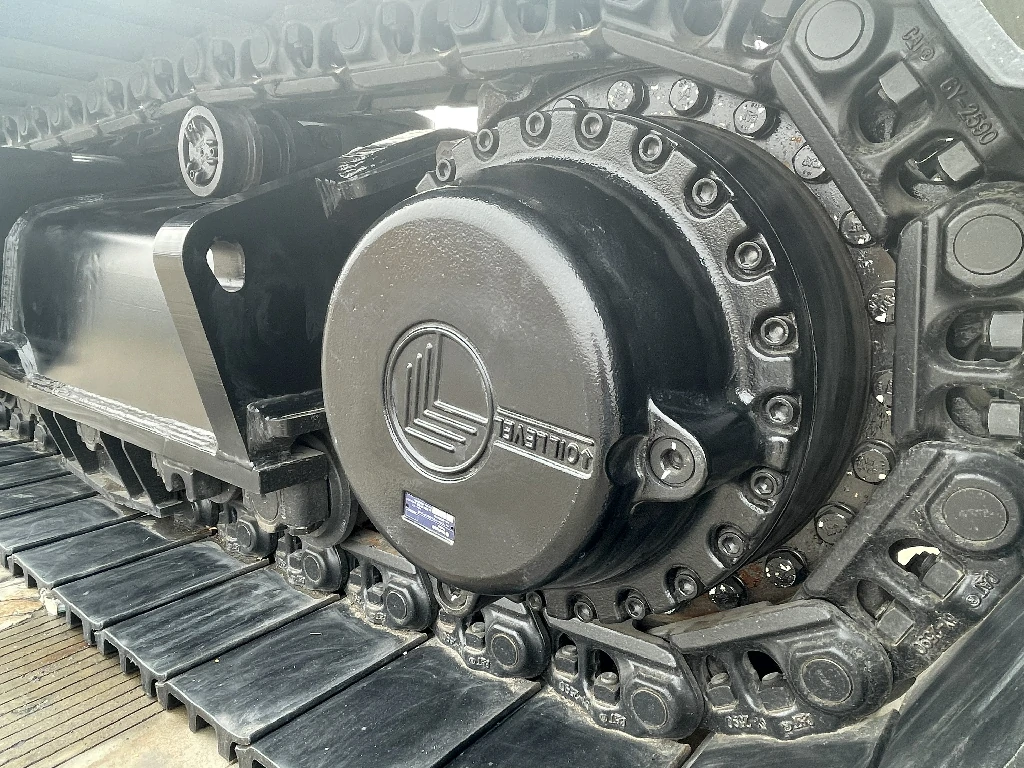
Where steel track undercarriages are the correct choice for a loader?
Quarry and mine face work. A loader working a quarry face or a stockpile handles broken rock at high cycle rates, and the conditions are exactly those that favour steel: a hard, abrasive surface where a rubber pad would wear out in a fraction of the working life, and heavy load cycles where mechanical bite is what moves the bucket. In a mine, the same logic applies with an additional factor — the machine works in a confined area with a lot of reversing and turning, and the frame and running gear need to survive contact with broken material.
Steel also wins where the loader is a long-haul machine within a site. A loader that shuttles between a face and a stockpile or a processing plant spends its life on abrasive surfaces, and a 5,000–8,000 working hour chain life is a materially different economic proposition from a rubber pad set replaced every 800–1,500 hours.
Underground or confined heavy work is the third case, where loaders move blasted rock in restricted spaces and the reliability of a welded Q345B frame and a full steel running gear outweighs any consideration of surface protection.
In all three, the common factor is that the surface is already broken or abrasive, so the ground-damage penalty that rules out steel elsewhere does not apply.
Where steel track undercarriages are the wrong choice for a loader?
Municipal and road works are the clearest case. A loader working on streets and pavements with a bare steel chain marks the surface, is materially noisier, and damages asphalt edges and kerb lines. On public roads this is a liability, not an inconvenience.
Yard and hardstand work is the second. A loader shuffling pallets and materials on a concrete yard will mark it, and the noise is a problem where the loader operates near people or in a warehouse environment.
Third is landscaping and site clearance where the ground must be preserved — a loader on turf or a soft landscaped area needs a wide footprint that will not rut. A rubber track undercarriage, with the load spread over the full pad width rather than concentrated on a grouser bar, is the correct answer. MAGEON's rubber track undercarriage family covers 1 to 15 tons for exactly this class of machine.
Fourth is a high-speed transfer duty. Steel tolerates speed better than rubber, but a loader running at speed across a hard surface still suffers accelerated wear and generates noise, and if the machine is travelling on paving, the surface damage compounds with every pass.
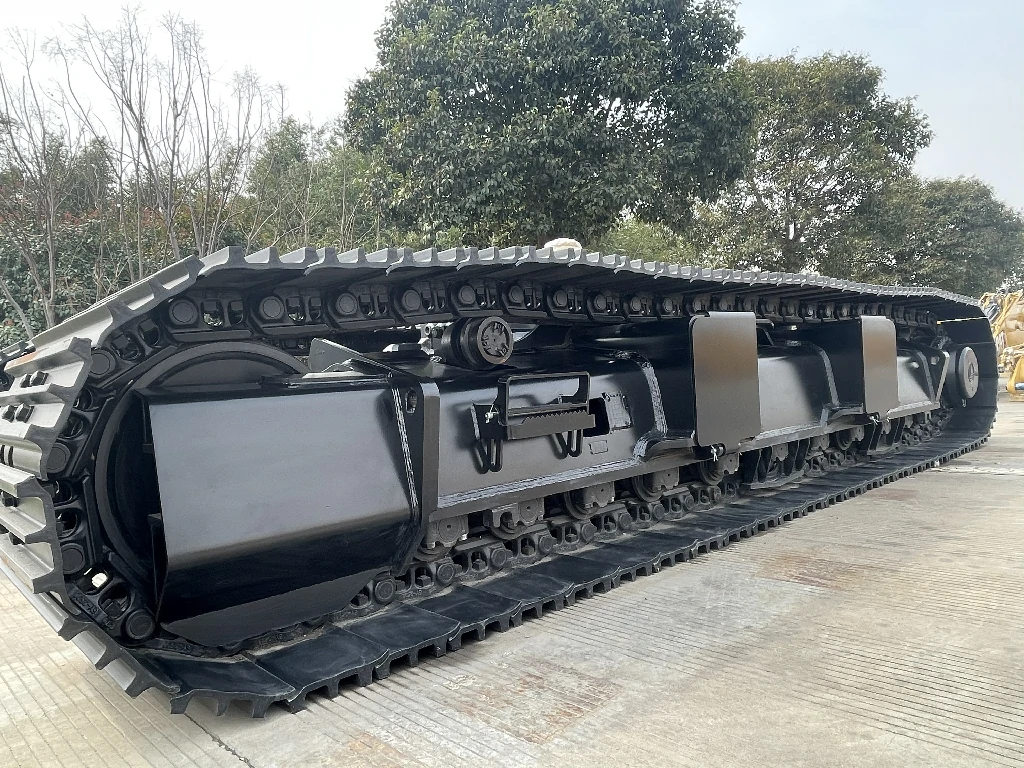
What is the rubber-padded steel track compromise?
It is the configuration most loader applications actually want, and it is what MAGEON's 3–15 ton rubber-padded steel track undercarriage is built for. The construction is a steel track as the load-bearing running base with rubber pads fitted to the track shoes. The steel chain retains the high load capacity, the mechanical traction and the wear resistance of a bare steel track, while the pads cut the scraping and indentation on asphalt and concrete.
The published specification for MAGEON's rubber-padded steel track undercarriage is a 3–15 ton load capacity, hydraulic drive, 2–4 km/h travelling speed, and overall dimensions of 2250 × 300 × 535 mm, with the dimensions themselves customisable. It is specified for drilling rigs, mobile crushers, mini excavators and piling machines — and the same logic applies to a loader that works a quarry but travels between the face and the plant on a road.
Note the 3–15 ton class. A larger loader wanting a padded configuration needs the requirement raised during the enquiry, because the pad arrangement and the frame load case are engineering decisions rather than a catalogue swap.
| Loader duty | Surface condition | Recommended configuration |
|---|---|---|
| Quarry face and stockpile | Broken rock, abrasive | Bare steel track |
| Underground loading | Confined, heavy cycle, broken material | Bare steel track |
| Site haul between face and plant | Abrasive haul road with some paving | Steel track with rubber pads, 2–4 km/h |
| Municipal and road works | Asphalt, kerbs, public surface | Rubber track, or rubber-padded steel |
| Warehouse and yard material handling | Concrete hardstand, noise-sensitive | Rubber track |
| Landscaping and turf work | Sward must not be rutted | Rubber track, wide footprint |
What is the noise and surface damage difference in practice?
Steel on steel — a bare steel chain running over a concrete or asphalt surface — is loud, and the noise scales with speed. A loader working a yard near a boundary or inside a building is a genuine problem, and in a specification review this is the objection that most often comes up. Rubber pads on a steel chain reduce the metal-on-metal impact noise substantially while retaining the load path.
On surface damage, the difference is categorical rather than a matter of degree. A bare steel grouser bar on asphalt removes material, and it does so in a pattern that is clearly attributable to the machine. A rubber pad on the same machine leaves a mark rather than a trench. Where a machine works on a surface that the customer considers valuable, that is the whole argument.
The counter-argument is on the other side: rubber pads wear out. MAGEON's planning figure for rubber pad life is 800–1,500 working hours, against 5,000–8,000 hours for a steel chain, and pads are replaced in sections rather than as a complete set. The failure mode to watch is visible steel cord exposure, which means the pad has to come off before the cord breaks and damages the sprocket.
How do you specify the right undercarriage for a loader?
Beyond the standard five inputs — machine weight and load distribution, mounting interface dimensions including bolt pattern and drive shaft height, required travelling speed, ground and duty conditions, and drive configuration — a loader enquiry should state where the machine travels as well as where it works. The operating surface, and specifically whether that surface is paved, is the input that decides between bare steel, rubber-padded steel and full rubber. It is worth spelling out as a separate line in the enquiry rather than folded into a general description.
Track width in the 200–500 mm range then follows from the machine weight and the ground bearing conditions, and travelling speed from the working pattern. A loader doing short-cycle face work travels slowly; one shuttling between a face and a stockpile travels further at moderate speed, and the MAGEON steel range covers 1–4 km/h accordingly.
On the drive side, hydraulic, electric and mechanical drive are all available, matched to the machine's hydraulic system parameters. Where the loader works long shifts underground or in a quarry, the drive package reliability is a factor worth specifying deliberately rather than accepting the default.
Frequently asked questions
Are steel track undercarriages suitable for loaders working in quarries?
Yes, and it is the ideal application. Broken rock is abrasive to a rubber pad, and a loader working a face or stockpile is the machine that most benefits from a chain with a 5,000–8,000 working hour planning life. Mechanical bite from the grouser bar is also what moves the bucket in the first place. For a loader that works a quarry but travels on a haul road with some paving, a steel track with rubber pads at 2–4 km/h is the appropriate variant, and MAGEON supplies that as a 3–15 ton class product.
Why are steel tracks not recommended for municipal and road works?
Because of surface damage and noise rather than performance. A bare steel grouser bar on asphalt removes material and leaves a clearly attributable track, and the metal-on-metal noise is substantial. If the machine has to work on a public road or a customer's finished surface, the correct specification is a rubber track or a rubber-padded steel track. The machine loses nothing in traction in these conditions, because the work itself is not breaking rock.
What is the difference between a rubber track and a rubber-padded steel track?
The load path. A full rubber track replaces the steel chain entirely, with the load carried through steel-cord-reinforced rubber pads and the steel frame, and gives the lowest ground pressure of the three — the right answer for soft ground and turf, limited to the 1–15 ton class in MAGEON's range. A rubber-padded steel track keeps the steel chain as the load-bearing base and bolts rubber pads to the track shoes, so it keeps the higher load capacity, the mechanical traction and the wear resistance of steel while reducing surface marking. The MAGEON rubber-padded steel track undercarriage is built at 3–15 tons, 2–4 km/h, 2250 × 300 × 535 mm.
How fast can a loader travel on a steel track undercarriage?
MAGEON's steel track undercarriage range covers 1–4 km/h, and the rubber-padded variant is specified at 2–4 km/h. A loader doing short-cycle face work would normally sit at the lower end of that range. Speed against broken rock and construction debris accelerates grouser bar and chain wear, so a machine whose travel route crosses such material should have the speed specified against that route rather than against its theoretical maximum.
How often do the wear parts need replacing on a loader undercarriage?
On a steel track undercarriage, lubrication runs at approximately 200–250 working hours, with scheduled inspection of track tension, and the chain, track shoes, rollers, idler and drive sprocket replaced as they reach their wear limit. On a rubber track, the pad set is the consumable at 800–1,500 working hours, replaced in sections, with spring-loaded idler tension that should be checked more often than a hydraulic tensioner. The welded Q345B frame is not a wear item in either case.
How long does a custom loader undercarriage take to deliver?
Approximately 20 days for one set and 30 days for two to three sets from approval of the configuration and interface, with longer timelines negotiated for volume orders. The minimum order quantity is one set. Every chassis ships with a one-year or 1,000-hour warranty under ISO 9001:2015 certification, with a factory inspection report, material mill certificate and video outgoing inspection available before dispatch. FOB is available at Shanghai, Ningbo or Shenzhen, with delivery by sea, air or land.